Patent quality refers to the legal validity, clarity, enforceability and commercial meaningfulness of a granted patent. Itis indicative of the extent to which the patent meets statutory and patentability requirements and determines its ability to withstand invalidity challenges in court or during enforcement.
A high-quality patent benefits inventors, competitors, investors, and the public by ensuring that exclusive rights are granted only for genuine innovations and that the scope of protection is clearly defined.
‘Patent Quality’ is used to describe a wide range of distinct constructs. The term implies strength, importance and value of the underlying invention and relates to its quality, which is an abstract concept that captures ‘how much better’ a product, process or technology is compared to those in prior art. Thus, it describes the invention’s productivity- or utility-enhancing characteristics, which afford it competitive advantage.
Patent quality also refers to not only the economic value or impact of the patented invention, but also the drafting quality of the patent and compliance with statutory requirements. A high-quality patent is one that also meets patentability criteria of novelty, utility, subject matter eligibility, inventiveness, enablement, and written description.
Legal validity is a critical aspect of patent quality. It means the application is properly vetted to ascertain the invention’s patentability and innovativeness. Overly broad claims, ambiguous language, or inadequate disclosure can result in weak or invalid patents, leading to infringement disputes and uncertainty over IP rights.
If challenged, a high-quality patent is highly likely to be upheld.
A high-quality patent document is well-written and easily understood. It clearly and precisely describes the inventive concept, contain a complete and enabling disclosure of the invention, and include claims that accurately and specifically define the boundaries of the invention.
While the claims should be broad enough to prevent competitors from easily designing around the invention, yet they should be narrow enough to not overreach into previously known technology.
Patent quality is dependent too on the diligence that the patent office exercises during the examination process. Examiners must conduct thorough prior art search to correctly assess patentability, and ensure compliance with statutory and regulatory requirements.
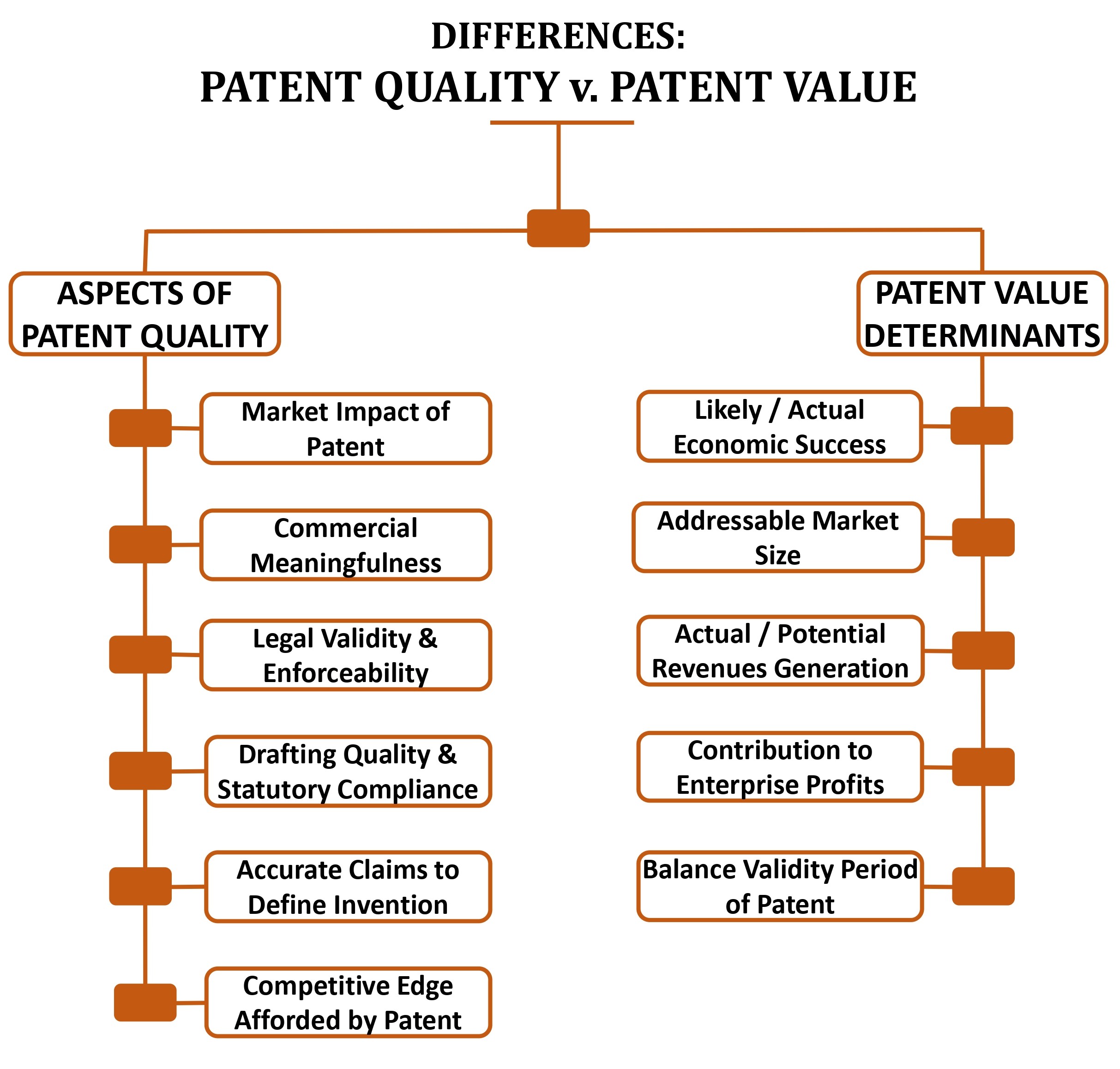
Patent quality is often confused with patent value. The focus of patent quality is typically on whether the patent was granted correctly and whether it provides clear, legally solid boundaries against infringement. Contrarily, patent value refers to the economic success of the invention itself―it depends on the invention’s market size, licensing revenue, and contribution to the enterprise profits.
Hence, it is evident that a high-quality patent can have low commercial value, because the underlying invention is not adopted widely and unable to gain traction in the market. Conversely, a weak, low-quality patent might generate immense revenue, perhaps because nobody has challenged its validity in court.
Improving patent quality entails collaboration among applicants, attorneys, examiners, and judicial officers. Judicial scrutiny through post-grant prosecution and litigation proceedings further strengthens the patent system by invalidating patents that fail to meet legal requirements.
Patent quality is a cornerstone of a robust innovation ecosystem. By conferring reliable and predictable IP rights, it balances the interests of inventors and society by rewarding genuine inventions. On the flip-side, low-quality patents lead to frivolous litigation; increase transaction costs; impede technological progress; and, create unwarranted monopolies and barriers to competition.
At BLAZEVENTURES, we have elaborate processes and qualified professionals for helping inventors and enterprises obtain high-quality patents for ideas, inventions, and innovations.