A patent claim is a concise and precise statement that identifies the invention’s essential technical features. Claims must be expressed with clarity, succinctness and supported by the descriptive matter disclosed in the specification.
The primary objective of claims drafting is to seek the broadest possible protection for the invention, without sacrificing the novelty, inventiveness and legal validity of the claims vis-à-vis prior art.
The process of claims drafting begins with identifying the inventive step or idea and distinguishing it from prior art. Patent applicants must analyze prior art diligently to determine the features of the invention that contribute to novelty and inventive step.
It is paramount to remember that claims are statements of technical facts expressed in legal terms that define the scope of the invention, for which patent protection is sought. Therefore, every word, phrase, clause and expression in a claim carries legal significance. Even minor changes to the language of a claim can substantially affect the extent of patent rights.
Claims may be drafted in various formats depending on the nature of the invention.
Product claims protect physical articles, devices, apparatuses, equipment, or systems; while process or method claims protect specific steps or procedures. In some jurisdictions, claims may also be directed to uses, computer-implemented inventions, or manufacturing operations.
Regardless of the nature of the invention, claims should be drafted with focus on the distinguishing features of inventiveness; however, unnecessary limitations that narrow the scope of protection should be avoided.
A well-drafted patent application typically incorporates multiple claim types to provide comprehensive protection. The claim is usually drafted as sequentially numbered paragraphs. The main claim is always stated first.
Claims can be either independent or dependent.
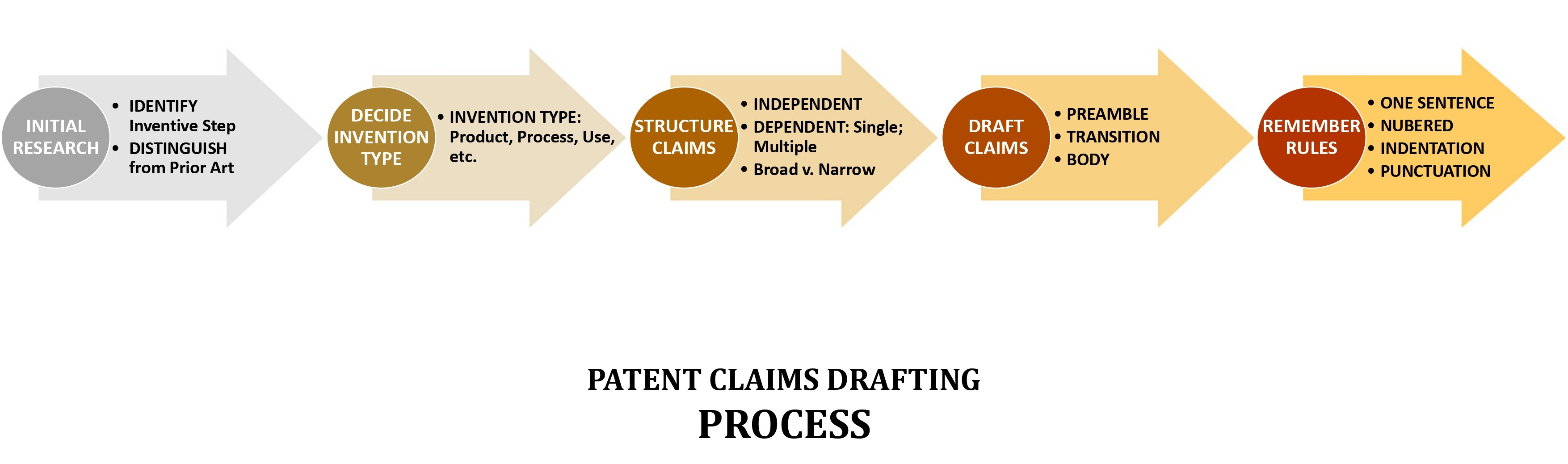
An independent claim stands alone and contains all the relevant and essential limitations needed to define the invention. The “innovative aspect(s) or feature(s)”, that is, the inventive step(s) that distinguish(es) the invention from prior art, must be incorporated into the claim.
An independent claim is composed of the following three parts:
Dependent claims reference back to a previous claim (either independent or another dependent claim) and add further limitations specific to the invention—hence, they narrow the scope down. Further, they incorporate all the limitations of the claim they depend on, saving you from repeating the entire description (For example: "The device of claim 1, further comprising a flexible swivel head...").
A multiple defendant claim refers back to more than one claim in alternative.
The fundamental rules of claims drafting include:
Patent laws and examination guidelines require drafted claims to not only satisfy standards of clarity, definiteness and unity of invention, but also find support in the specification. Ambiguous language, functional claiming without adequate support, or excessive breadth can result in objections from patent examiners.
Claims drafting is the linchpin of the patent application process— it transforms an inventive concept into a bundle of legally enforceable rights, by precisely and comprehensively defining the scope of the invention and the exclusivity sought therefor. Hence, it is imperative for a patent practitioner to have a blend of technical understanding and legal expertise.
Needless to say, strategically drafted claims significantly enhance the value, strength, and enforceability of a granted patent.
At BLAZE VENTURES, we have elaborate processes and qualified professionals for advising inventors and enterprises on not only claims strategy, but also claims drafting to effectively protect IP rights over inventions, innovations and improvements