Patent application amendment is a vital aspect of the patenting process. It permits applicants to alter, clarify, correct, modify or finetune their legal claims, explanatory disclosures, technical drawings, and invention description during the prosecution process.
Because patent application drafting requires clarity, conciseness and precision, applicants at times need to revise their filings. Further, it is most frequently used to overcome examiner's objections or to refine voluntarily the scope of the invention with explanations, corrections and disclaimers.
The aim is to ensure that genuine inventions receive proper protection, while maintaining accuracy, fairness, clarity, systemic integrity and statutory compliance. Patent law frameworks in almost all jurisdictions, including the United States, India, Europe, etc., provide specific provisions governing amendments to patent applications.
Amendment of filed patent applications is permissible under law only in limited circumstances. Common reasons for amendment include correcting typographical errors, clarifying the scope of claims, removing ambiguities, or distinguishing the invention from prior art cited by the patent office.
Amendments can be in respect of the specifications, detailed description, claims, drawings, or other documents filed with the application. But it is strictly mandatory for amendments to find clear support in the original filing. Inventors cannot add new experimental data, broader concepts, technological features or late-stage discoveries during the pendency of their patent applications.
Thus, the primary restriction governing amendments is the prohibition against introducing "new matter" beyond what was originally disclosed in the specification. This rule preserves fairness and prevents applicants from expanding their inventions or broadening the scope of claims after filing. Amendments are usually sought to limit, clarify, or disclaim certain aspects of the invention.
If an applicant wishes to add new technical information, then a separate continuation-in-part application, which establishes a later priority date for the added material, must be filed.
Based on the stage during which amendments are to be effected during the prosecution process, they are categorized as: preliminary and responsive. Thus, amendments can be made both before or after the patent grant, depending on the jurisdiction.
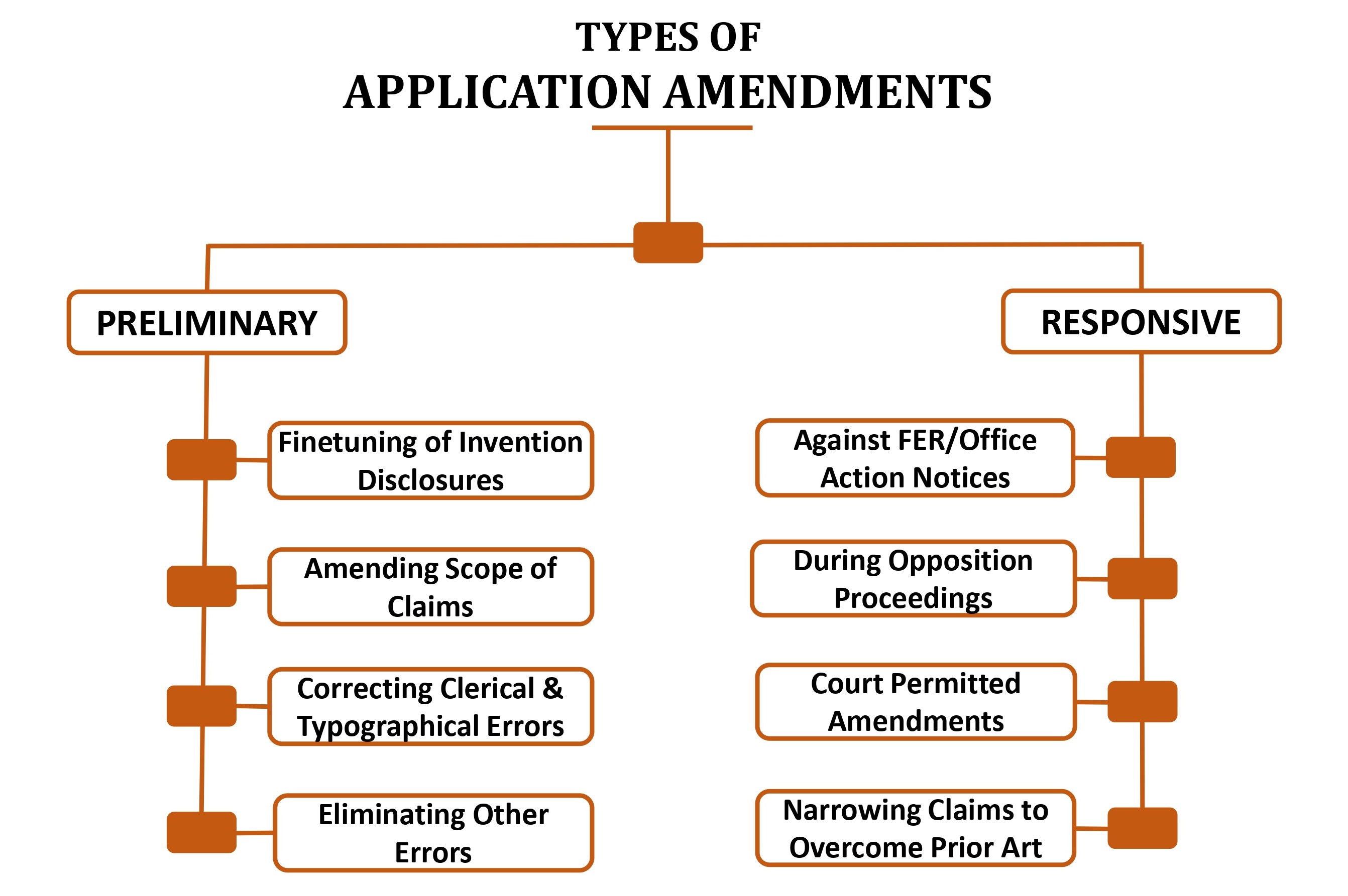
Before examination, applicants may amend claims voluntarily to strengthen patentability. Such preliminary/voluntary amendments are submitted prior to the examiner’s initiation of office action or issue of first examination report (FER); they are, in general, aimed at: (a) calibrating invention disclosures; (b) streamlining scope of claims; and, (c) correcting clerical, typographical or other errors, such as, spelling mistakes, grammatical oversights, etc. in the specification.
Post examination, amendments are generally made in response to objections raised in the FER/office action or during opposition proceedings or even after grant, subject to statutory restrictions. In some cases, courts too may permit amendments during patent litigation, if they do not prejudice the rights of third parties. The discretion “whether or not to allow amendment is a wide one”, as noted in Smith Kline and French Laboratories Limited Vs. Evans Medical Limited.[1]
At times, amendments are made to narrow claims for the purpose of bypassing existing technologies or overcoming prior art in response to the examiner’s rejection of certain claims. The endeavor of applicants is always to retain the broadest possible commercial protection.
The amendment mechanism plays a significant role in balancing the right to fair protection of inventors with the interest of the public in ensuring legal certainty of the protection; the process encourages innovation.
For inventors, it provides flexibility to refine claims and secure valid IP rights protection for their inventions. While tightening of claims helps in securing patent grant, it also invokes the doctrine of prosecution history estoppel, which prevents patentees from later reclaiming scope they surrendered during prosecution. For the public, it ensures that patents are granted only for clearly defined and properly disclosed inventions.
Excessive or improper amendments may delay patent prosecution and create uncertainty in respect of the scope of protection. Consequently, patent amendments require a careful equilibrium: they must be precise enough to satisfy examiners and other authorities, yet broad enough to maintain robust commercial value.
Ultimately through, the amendment process requires strategic navigation.
At BLAZE VENTURES, we have elaborate processes and qualified professionals to advise inventors and enterprises on both preliminary & responsive amendments for effectively creating, protecting and monetising IP rights over ideas, inventions, innovations and improvements.
____________
[1] 1989 (1) Fleet Street Reports 561; p.569.