The term “submarine patent” refers to a patent, the application and issuance of which the applicant intentionally delays for an extended time. It remains hidden from public knowledge for a protracted period.
Thus, such a patent, like a submerged submarine, emerges unexpectedly to be enforced against businesses that have unknowingly adopted the patented invention. The term often has a derogatory connotation.
Historically, the phenomenon gained prominence under the former U.S. patent regime, wherein applications were kept confidential until the grant of patents. Hence, applicants could intentionally prolong prosecution by filing continuation applications, amending claims, or delaying responses to patent office communications.
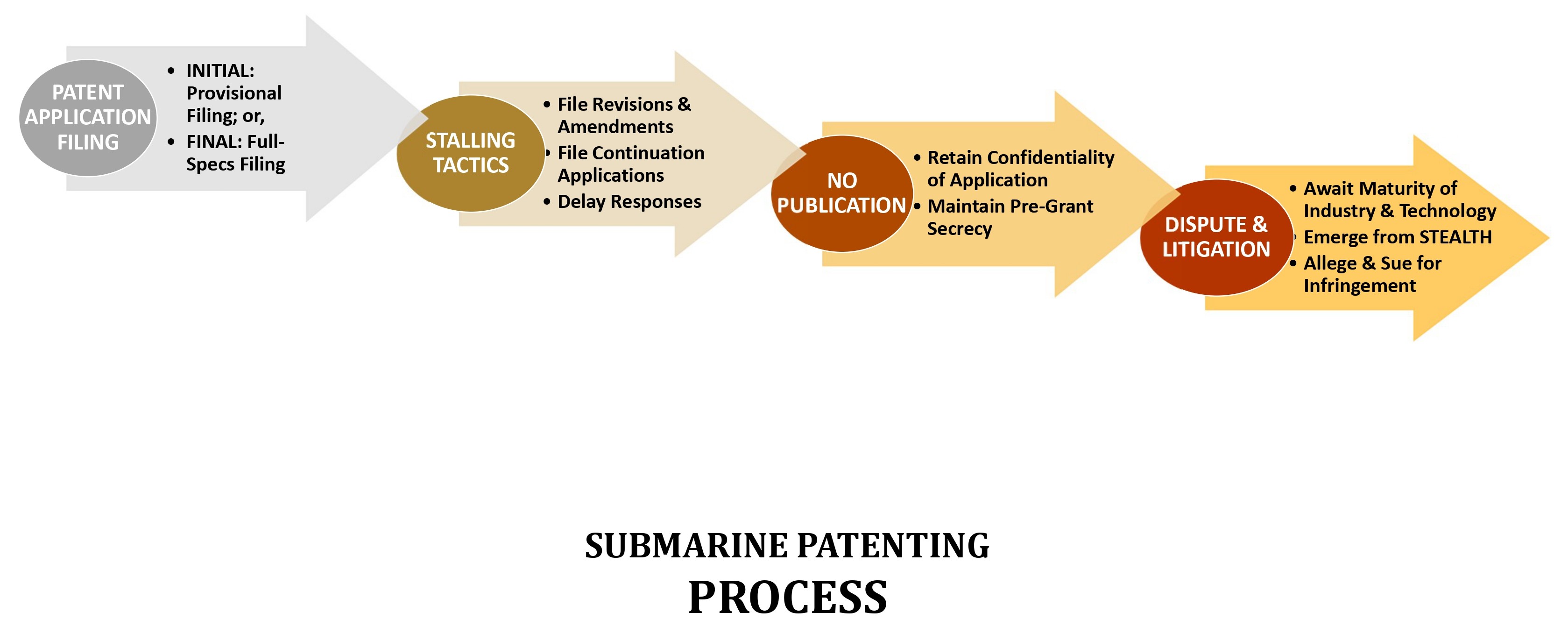
A patent, in the result, could be granted several years after its initial filing, often after an industry had widely adopted the relevant technology. The patent holder then could assert rights against unsuspecting companies, seeking substantial licensing fees or damages.
The process of submarine patenting, particularly under the US patent law regime prevalent in the past, entailed the following steps:
Inventors and enterprises frequently embraced the ‘submarine patent strategy’ to entrap large industry players and market leaders. So, instead of being detrimental, the stalling of publication of patent applications increased the value of granted patents, which often would pertain to mature, not nascent, markets.
Submarine patents obviously created substantial uncertainty for inventors and businesses; it was a stumbling block for genuine innovators, who found it difficult to assess the true landscape of existing patent rights. Companies investing heavily on research, product development, and commercialization ran the risk of infringement claims and suits based on patents that had not been publicly disclosed.
Hence, reforms were introduced in US and global patenting laws to effectively counter the legal loopholes. Legislative amendments revolved around:
By virtue of legislative reforms in most jurisdictions (including the US), the classic submarine patent has mostly become obsolete. Yet, the concept illustrates the need for a balanced patent system, wherein: (a) IP rights are protected with legal certitude, fairness, and transparency; (b) innovation is fostered and competition not stifled; and, (c) public interest and confidence in the patenting system are upheld.
At BLAZEVENTURES, we have elaborate processes and qualified professionals for advising inventors and enterprises strategically on the effective creation, protection and commercial exploitation of IP rights over their ideas, innovations and inventions.