Intellectual properties (IP) are no longer purely protective legal and proprietary rights; they have evolved into strategic business assets capable of generating significant revenues. Effective wealth creation from patents, trademarks, copyrights, designs, and trade secrets entails the recovery of tangible economic value from them, without sacrificing broader strategic and commercial objectives over the long haul.
In modern business, monetisation of IP assets must be viewed not as one-off transactions, but as well-planned strategies for generating revenues sustainably. Hence, patent monetization strategies focus on generating revenue from the IP assets.
Businesses typically prefer to directly monetise IP assets by leveraging rights to differentiate, position and target segments effectively; and, command premium pricing, and strengthen market presence.
A most common IP monetisation method is licensing, through which the IP owner permits licensees to use the patented invention in return for valuable consideration. This approach allows IP owners to earn recurring incomes without investing in and/or incurring manufacturing or distribution costs.
Licensing can be exclusive or non-exclusive; or, cross-licensing. In general, market conditions and competitive considerations drive the transaction, which may be based on royalties, lumpsum or periodic fees, or milestone payments.
Another option is outright sale or assignment of IP rights, typically to IP firms or competitors. The consideration therefor can be paid either in lump-sum or on a deferred payment schedule. It obviously provides immediate liquidity. However, it also entails forgoing future revenue and cashflow potential. Hence, this option is used in cases wherein the IP does not align with the owner’s core business, or when capital is required urgently for growth or restructuring.
Joint ventures and strategic partnerships are also avenues available for monetising patents. By pooling complementary IP assets, parties can co-develop products, generate revenues jointly, share profits and access new markets. This approach is particularly valuable where innovation costs are high and regulatory barriers are significant.
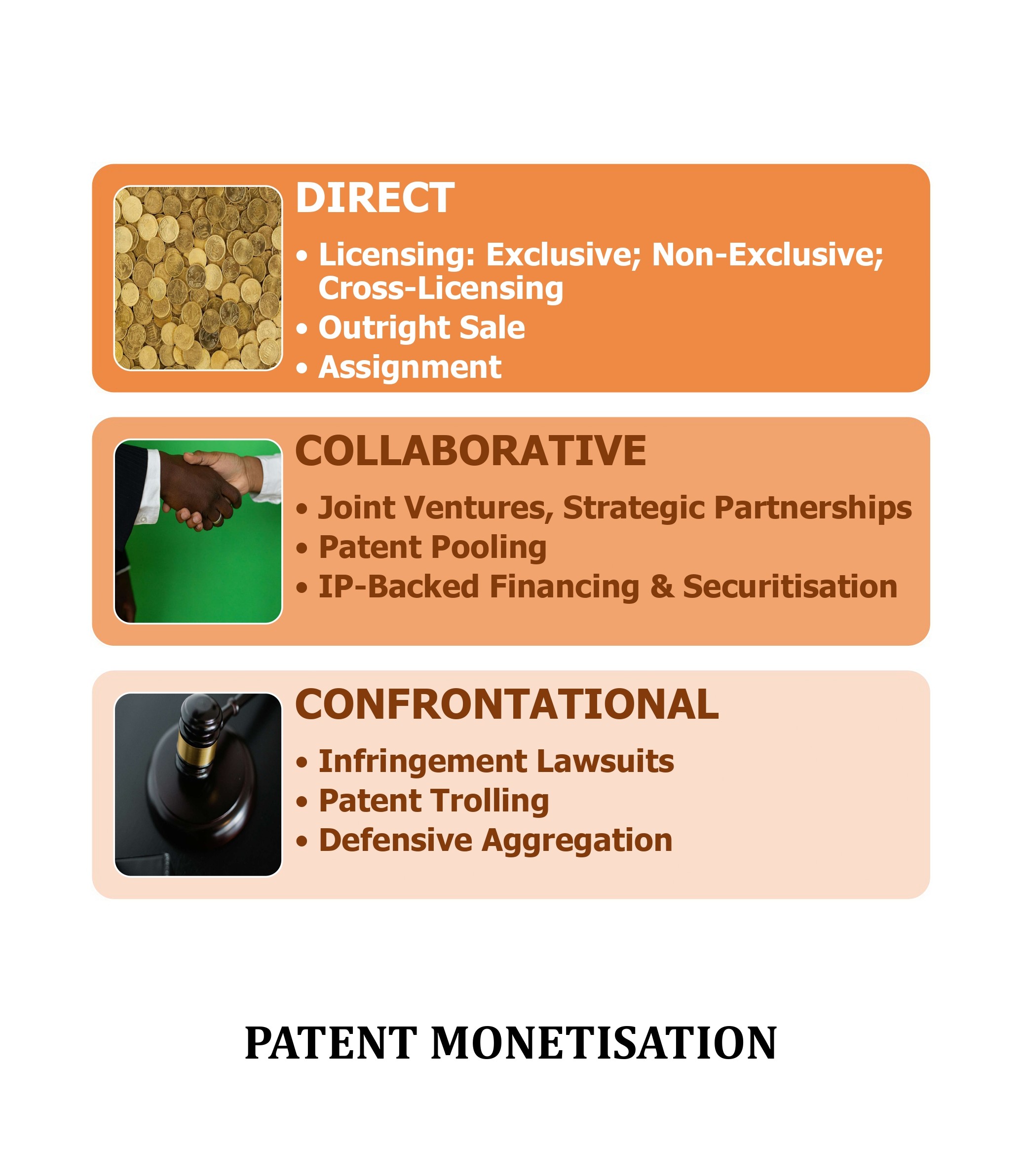
Patent pooling is an approach in which entities combine patents to create a more valuable and impregnable IP fortress for effective monetisation. IP-backed financing and securitisation are also emerging monetisation tools. Patents, as a measurable financial asset class, can be leveraged as collateral for mortgages or used to attract investors.
Enforcement of IP rights is an alternate, albeit more aggressive, option. Patentees initiate legal proceedings to assert rights against infringers. Besides protecting market share, this mode can be used to seek punitive and compensatory damages, settlements, or other agreements.
Patent trolling is often adopted as a method for forcing settlements or extracting license fees. While such lawsuits can potentially yield substantial returns, they carry financial and reputational risks, besides legal uncertainties. Defensive aggregation is sometimes used to acquire patents for protecting against infringement lawsuits.
An effective monetisation strategy ensures that patentees reap the financial rewards they deserve. This requires the accurate determination of the patent's worth for both licensing and selling. Multiple valuation methods (based on cost-, market-, and income-based approaches) are frequently used. Other terms, such as, royalty rates, exclusivity provisions, territorial scope, etc., are also vital in agreement negotiations.
Often filing a series of inter-connected patents, and building a “patent wall” helps strengthen the company’s competitiveness; deter imitation; and, convert successfully IP rights into financial returns.
In conclusion, IP can be monetised effectively with a balanced strategy that blends technical strength, market insight, legal imperatives, and business foresight. A good understanding of business goals and the patent's market value is crucial for selecting the right strategic path. With the right mix of licensing, partnerships, enforcement, and internal exploitation, enterprises can unlock the full economic potential of IP assets.
At Blaze Ventures, we have elaborate processes and qualified professionals for strategically advising inventors and enterprises on effective monetisation of patent rights.