A patent is an exclusive legal right that a competent governmental authority grants to an inventor for a limited period—typically 20 years from the filing date—to exclude others from making, using, selling or otherwise commercializing an invention. As a type of intellectual property, patents confer monopoly rights on the inventor in exchange for publicly disclosing the technical details of the innovation
However, the patenting process can be expensive and varies depending on the country, complexity of the invention, and the scope of protection sought. The term ‘cost of patenting’ refers to the total expenditure involved in obtaining, maintaining, and enforcing a patent for an invention.
Inventors typically get a prior art search (also referred to as landscape research) carried out to determine whether the invention satisfies patentability criteria. This validation may require professional services of patent agents or attorneys, whose fees can be considerable― often in the US$125―500 per hour range; it varies depending on the country of filing.
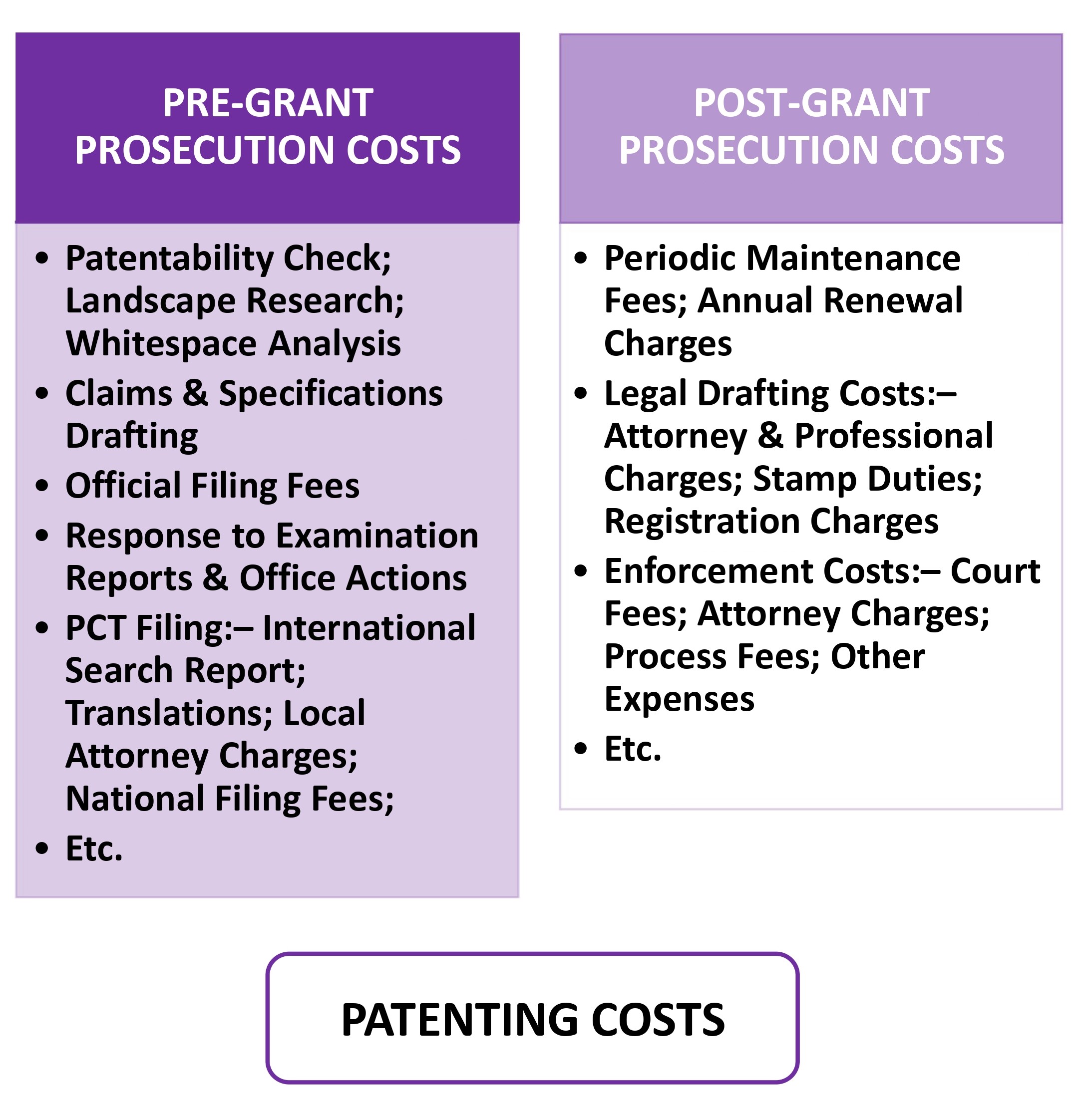
Drafting of patent claims and specifications is another significant expense, as the application must clearly describe them. Since patent law is technical and complex, many inventors hire patent agents or attorneys.
Official filing fees payable to the patent office are another major head. These fees differ according to the jurisdiction and the status of the applicant, such as, small entity, individual, startup, or large corporation. Many countries provide subsidized fee structures for startups, universities, and individual inventors. Often the fees are linked to the patent application length and the number of claims therein; discounted fee structures are applicable for electronic filing of applications.
During the prosecution stage, expense is incurred on the examination of the application filed. If expedited examination is sought, then additional fees may be payable. Patent offices may issue objections or requests for clarification, commonly known as examination reports or office actions. Responding to these often requires professional assistance, amendments, and further fees. If the invention is complex or faces multiple objections, prosecution costs may rise considerably.
In general, patent attorney charges for drafting and responding to objections constitute the bulk of the cost during pre-grant prosecution.
Patents are territorial rights; therefore, protection in one country does not automatically extend to another. While no concept of "world or global patent" exists, the Patent Cooperation Treaty (PCT) allows an initial filing that can later be converted into national patents.
For seeking protection in multiple countries, it is necessary for the inventor to separately file applications. An international search report is often a prerequisite too. Translation costs, local patent agent or attorney charges, and national filing fees can make international patent protection very expensive.
Periodic maintenance fees or annual renewal charges must be paid too to keep the patent in force throughout its term. Failure to pay renewal fees may result in lapse of the patent. These fees generally increase over time.
Further, engaging a qualified patent agent or attorney is advisable for robust IP protection. Legal costs (attorney fees, stamp duties, registration fees, etc.) may be incurred too on such advisory, professional and agreement drafting services for post-grant patent monetisation.
Finally, there may be enforcement costs if the patent is infringed. Litigation, licensing disputes, and court proceedings can be extremely expensive, particularly if the stakes are high. The total patent infringement litigation costs include court fees and vary depending on estimates of sustained damages and compensation claims; they often exceed the original filing costs.
The total costs can vary depending on the geographic extent of patenting requirement, complexity of the invention and the need for legal representation. Utility patent costs are generally much higher (about 10x) than that for design patents.
Creating and protecting IP rights for inventions generally takes about 3-5 years; it roughly costs between US$25,000―250,000+ for protection across roughly 5 to 15 major countries and geographies. However, the costs can be optimised with a solid patenting strategy, which defines IP protection goals, focuses on major markets & product-lines and prioritizes countries to limit scope and extent of protection.
Although costly, patenting can provide valuable commercial returns, competitive advantages and legal protection, making it worthwhile when the invention has strong market potential.
At BLAZE VENTURES, we have elaborate processes and qualified professionals to help inventors and enterprises effectively create and protect IP rights over their ideas, inventions and innovations.