Claims are the most vital part of a patent application; they set the legal boundaries of the invention and define the scope of legal protection sought. They are structured, single-sentence definitions of various aspects of the invention that the inventor wishes and seeks to protect.
While specifications describe the invention in detail, claims determine the bounds of exclusive rights that the patent office may grant. Consequently, effective claims drafting is a critical skill in patent practice and often determines the commercial value and enforceability of a patent.
Claims are generally categorized based on hierarchy (scope) and subject matter.
A claim is a portion of the specifications; its function is to define clearly and precisely the monopoly claimed, such that others may discern the exact boundaries of the invention. Patent applicants are under a statutory obligation to submit the claims for the invention.
The object of claims is to accurately delimit the invention, for which the patent application is filed. Another object is to demarcate the scope of the invention, which others cannot infringe after the patent is granted and the IP rights therein are protected. What is not claimed is disclaimed automatically.
In effect, the object of claims is to limit and not to extend or enhance the monopoly.
Hierarchically, claims are classified as independent and dependent claims. An independent claim (also referred to as, ‘standalone claim’) stands on its own; it defines the core invention in its entirety without referencing other claims. An independent claim contains all the essential elements required to define the invention. They are the broadest and establish the primary scope of legal protection
A dependent claim references back to another (preceding) independent or dependent claim; and, it narrows the scope of the predecessor claim by adding specific details, optional features, or other limitations. This hierarchical structure enables applicants to secure protection at different levels of scope, providing fallback positions in the event that broader claims are challenged during examination or litigation.
Omnibus claims are also used to broaden the scope of the invention beyond the included claims. Phrases such as ‘substantially as described herein’ and ‘substantially as described with reference to the drawings’ are good examples of commonly used omnibus claims.
The type of invention also impacts the claim typology. Product claims help protect the intellectual property rights over inventions of physical tools, devices, systems, machines, equipment, apparatuses, etc., such as, say, an ‘AI-based automatic translation’ device. They are used for all articles of manufacture.
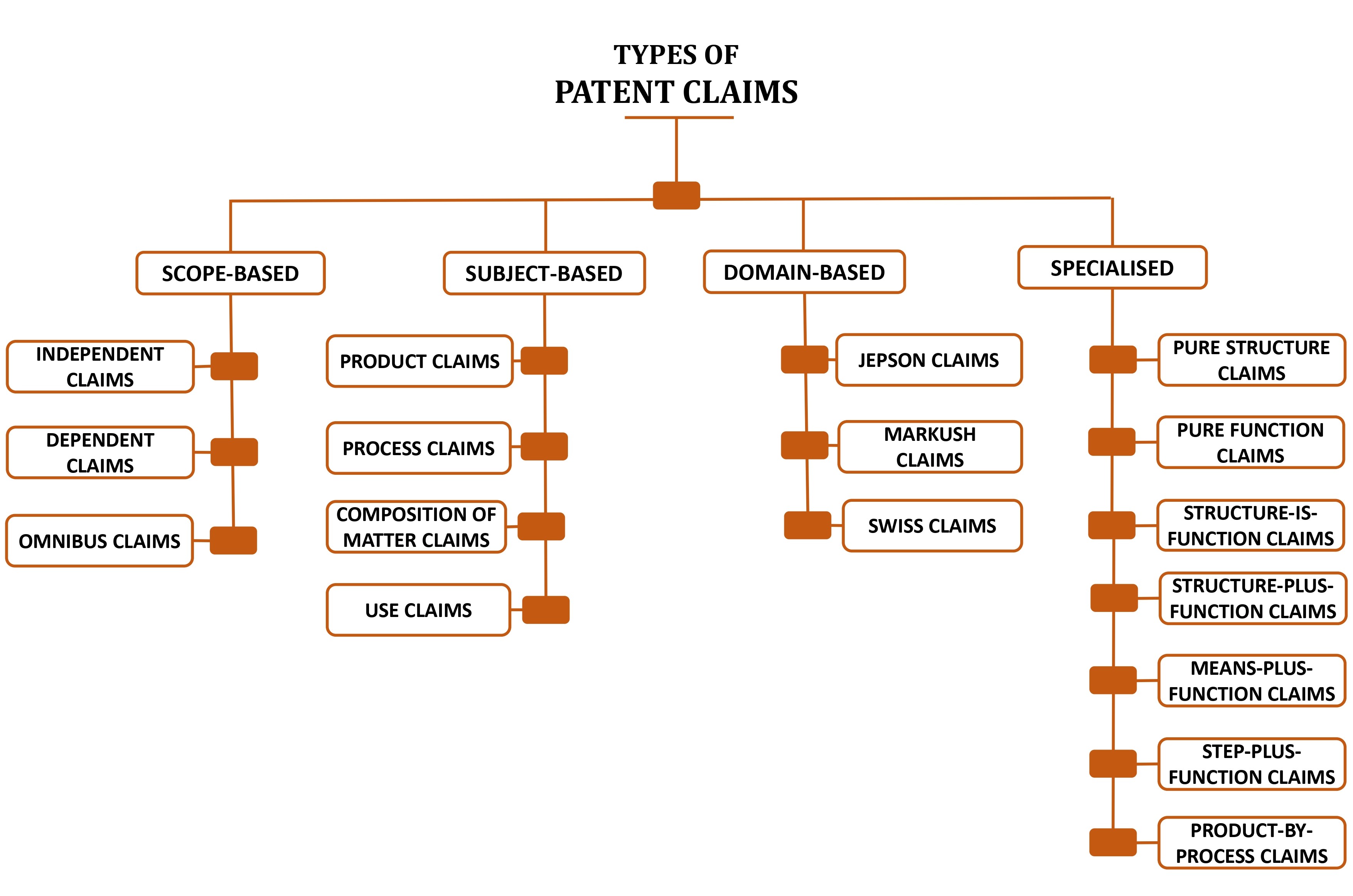
Process (or, Method) claims are useful for protecting the sequence of acts, steps or phases performed to process certain input(s) to obtain a desired output or achieve a specific result, such as, say, a ‘sintered glass production” method. These claims are most frequently used for patenting manufacturing processes, procedures and techniques.
Composition of matter claims relate to the protection of chemical inventions, such as, alloys, mixtures, new materials, compounds, substances, formulations and other matter. Use claims are used for protecting the use, utilization, employment or application of a known device or substance for a novel, specific purpose, such as, a ‘formulation for treating malaria’.
Jepson claims are a two-part format that explicitly states known, existing elements in the preamble, followed by the novel elements and innovative improvements of the invention. They are used in process or product claims, wherein the invention is a modification or improvement over existing technology. The word ‘wherein’ is used to transition to the innovation idea, as in, for instance, “an assembly comprising an outer shell...wherein a plurality of inner shells is provided.”
Markush Claims are a type used for chemical inventions that have to be described in a structural diagram- or formula-based. The claim lists alternate elements or compounds from which a selection can be made, as in, for example: “a compound having the formula: R‐CH=N, where: R is an alkyl group selected from the group consisting of methyl, ethyl and isopropyl.”
A claim drafted so as to claim a new medicinal use of known substances or compositions is known as a Swiss claim. Example: "Use of Taxol...to prevent severe anaphylactic reactions, for simultaneous, separate, or sequential application...for treating cancer and simultaneously reducing neutropenia." Some jurisdictions, such as India, do not allow this type of claim.
A pure structure is a method of structuring claims structurally link physically apart of an invention to another part thereof, as in: “a switch connected to the fan”. A pure function is a method of structuring claims to functionally link a part of an invention to another part thereof, as in, say: “a signaling lamp with the switch”.
Contrarily, structure- is-function claim is used when the invention itself is descriptive of the structure and/or function. Example: “a signaling lamp”. On the other hand, structure-plus-function is a method of structuring claims to link a part of an invention functionally to another part thereof, as in: “a switch for controlling a signal to a fan”.
Means-plus-function claims describe a feature by the function it performs rather than its physical structure, as in, say, “a means for signaling with a light source.” A step-plus-function claim is used where a part of the invention is a step for a function of another part thereof. For instance, “a step for signaling the light source with a switch.” Contrarily, a. Similarly, product-by-process claim defines a product based on the unique process used to produce it, normally because the product itself is difficult to describe physically or structurally.
At BLAZE VENTURES, we have elaborate processes and qualified professionals not only for advising inventors and enterprises on claims strategy, but also for claims drafting to effectively protect IP rights over inventions, innovations and improvements.