Whitespace analysis is a vital and strategic patent intelligence technique used for identifying unexplored gaps, undetected needs or under-patented niches in functional aspects and technological areas of any particular industry.
In other words, in the context of patent strategy, the term ‘whitespace’ refers to latent gaps in the technology landscape that afford opportunities for the protection of innovative ideas and patentable inventions; needless to say, such gaps in prior art can be exploited for developing and enhancing products, processes, etc.
The main objective of whitespace analysis is to discover potential innovation opportunities. That is, this technique helps uncover ‘what’s missing’ in state-of-art, rather than ‘what’s existing’ therein.
The process begins with patent landscaping. The endeavor is focused on collecting and examining, within the relevant technical domain, published and granted patents, besides scholarly articles and research papers. Various search criteria, such as, filing dates, keywords, citations, jurisdictions, assignees, inventors, claim coverage, and classification codes are used for the analyses.
Many commercially available patent analytics platforms offer data visualization, artificial intelligence & machine learning (AI/ML) tools and techniques for processing, manipulating and interpreting large volumes of patent data. Extracted results are then plotted onto multi-dimensional maps and charts, such as, heatmaps, scatter plots,3D graphs, etc. The generated graphs illustrate patent activity concentrations—crowded spaces therein represent fiercely competitive landscape; and, sparsely populated areas indicate relatively less IP protection activity.
Spaces on these maps with little or no patenting coverage are referred to as whitespaces, which help with gap identification. Patent professionals then review the highlighted gaps—this validity assessment helps to ascertain if the gaps: (i) represent active whitespaces (real, patentable opportunities); or, (ii) signify inactive whitespaces (voids created by structural, regulatory, or scientific barriers.
Whitespace analysis provides several strategic benefits.
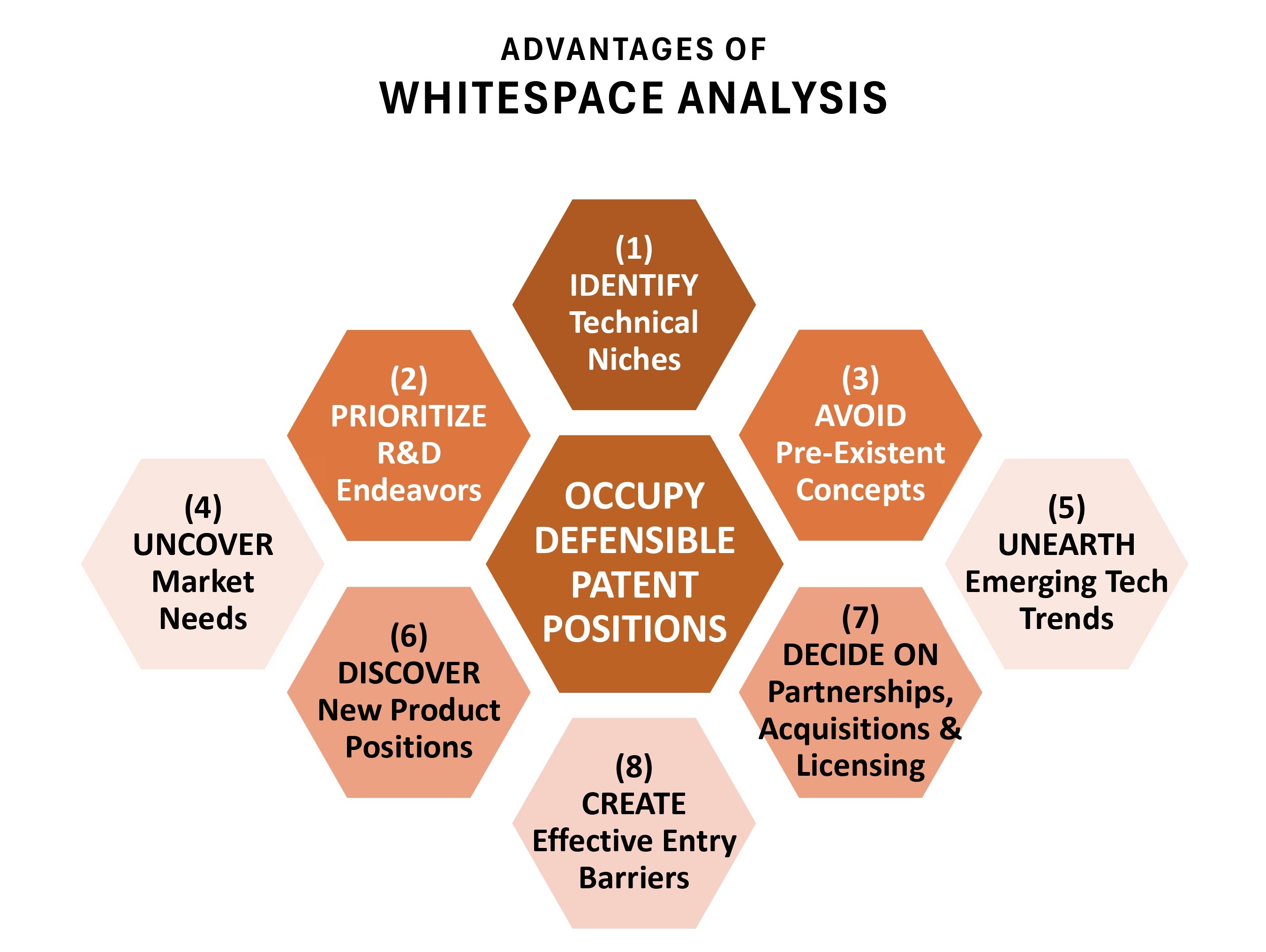
Firstly, it identifies niches in the technical landscape that are sparsely protected with existing patents. This helps enterprises prioritize their R&D endeavors on aspects that are more likely to yield innovative and patentable ideas, while minimising exposure to infringement risks. Organisations can avoid replicating pre-existing concepts too.
Further, it helps with proactive innovation—by uncovering emerging technology trends, latent product opportunities, unmet market needs, and new differentiation avenues. Strong IP assets obviously serve as entry barriers for competitors.
Then again, identifying whitespaces assists in the development of robust patent portfolios, which can occupy valuable and defensible positions within the landscape. Enterprises can also navigate R&D efforts around heavily-patented areas, thereby mitigating risks of expensive infringement lawsuits.
Whitespace analysis can also help with licensing, acquisition, and partnership decisions by highlighting technologies that complement existing IP assets. Finally, for startups and new market entrants too, whitespace analysis can identify niches where competition is limited and entry barriers are relatively low.
The presence of a distinct whitespace does not necessarily indicate a viable commercial opportunity. Often such gaps may exist because the underlying concepts perhaps are technically impractical, economically unattractive, or protected through trade secrets.
Patent publication delays and limitations in search techniques too may lead to inaccurate and incomplete conclusions. Hence, it is imperative that the results of whitespace analysis be viewed with a certain degree of circumspection.
Effective whitespace analysis mandates that patent landscape assessment be combined with technical evaluation, market research, and business strategy. When properly conducted, it enables organisations to innovate efficiently, build sustainable IP assets, strengthen patent positions, and identify valuable avenues for business growth in an increasingly competitive technological environment.
Therefore, whitespace analysis is a valuable technique available for R&D teams, patent professionals, corporate strategists and business leaders. It helps enterprises create entry barriers, secure competitive edge and achieve growth sustainably.
At BLAZEVENTURES, we have elaborate processes and qualified professionals for performing whitespace analysis and providing inventors and enterprises with strategic insights on creating strong patent positions.