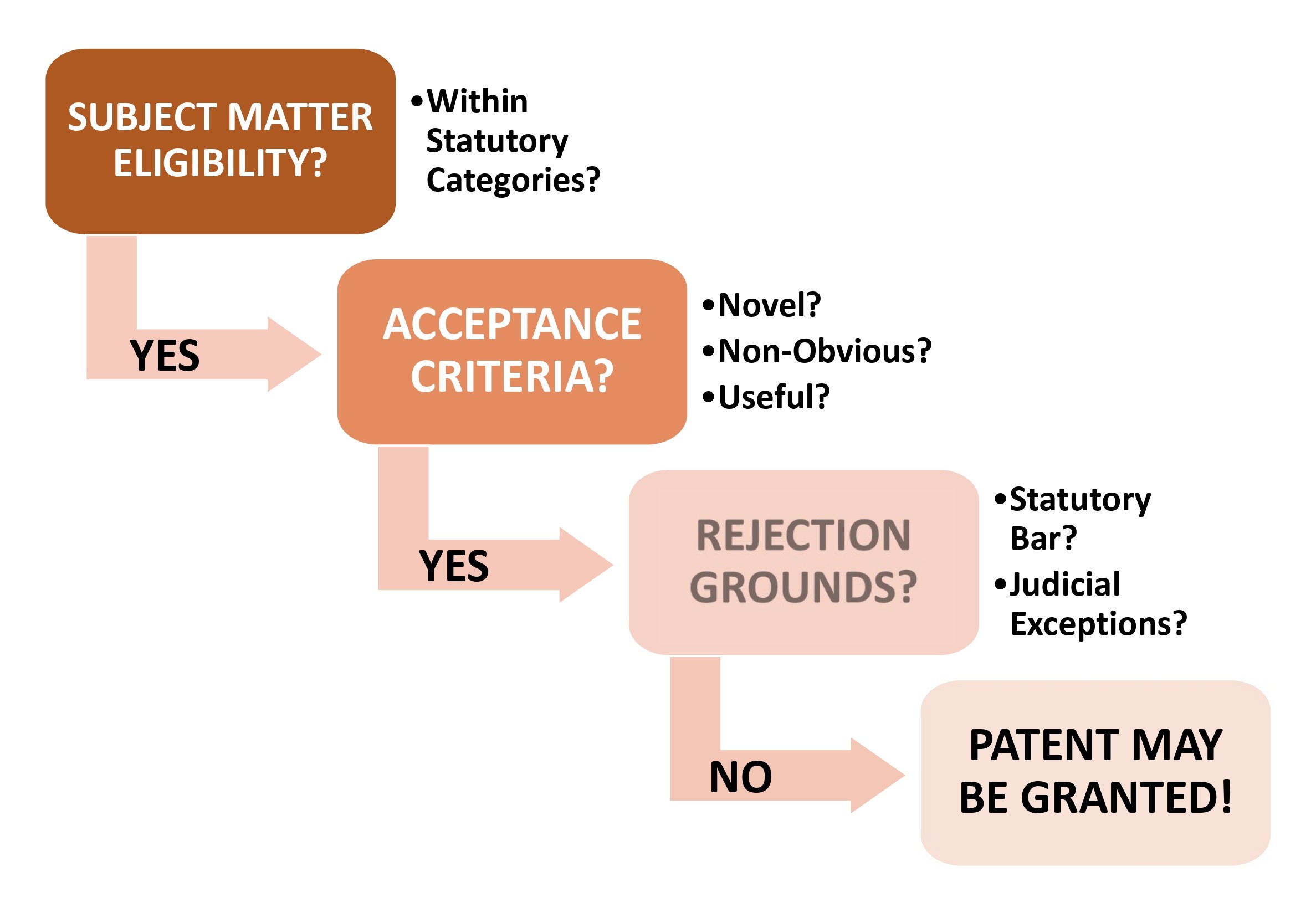
Subject matter eligibility (SME) is a foundational principle in patent laws of many jurisdictions that determines whether an invention qualifies for patent protection. For instance, under 35U.S.C. § 101 of the America Invents Act (AIA), four categories of eligible subject matter are defined, namely, process, machine, manufacture, or composition of matter.
The term essentially refers to the requirement that an invention must fall into a statutorily defined category and not be a judicial or statutory exception, such as, a law of nature, natural phenomenon, or abstract idea. For a patent to be granted, the invention must not only satisfy criteria like novelty and industrial applicability, but also have subject matter eligibility.
Under US Patent Law, the categories of invention are: (a) process, which is, ‘an art, method or series of steps performed to produce a specific outcome’; (b) machine, that is, ‘a device or mechanism’;(c) manufacture, which means, ‘a product or item that is made’; and, (d) composition of matter, which refers to ‘a combination of elements or chemical compounds.’
Under the patent laws of the European Union, a patent can be granted for any invention, in all fields of technology, provided it is not expressly excluded under other provisions. Contrarily, under Indian laws patents can be granted for products or processes.
Yet, simply fitting into one of the defined categories does not guarantee eligibility. Courts and statutes have intervened to ensure that fundamental scientific concepts remain accessible to the public. For example, mathematical formulas or naturally occurring gene sequences are considered discoveries rather than inventions, and thus cannot be patented.
In some jurisdictions, the judiciary has carved out exceptions to patent-eligible subject matter to prevent the monopolization of fundamental scientific knowledge. These judicial rulings are intended to prevent individuals or companies from monopolizing the basic tools and ideas of scientific and technological work.
For instance, the US Supreme Court has ruled that: (a) laws of nature— fundamental physical laws, i.e., principles of physics; (b) natural phenomena— naturally occurring things, or, products of nature; and, (c) abstract concepts and ideas—mathematical formulas and organizing methods for human activity are ineligible for patent protection.
In other geographies, express statutory provisions list such exceptions, which constitute grounds for ‘rejection’ of patent applications.
Itis important to distinguish subject matter eligibility (SME) from other patentability criteria, such as novelty, non-obviousness and utility. Eligibility is the first threshold an invention must pass before these other requirements are even considered.
Thus, to be eligible, a patent claim must fall first within one of the statutory categories, and second, it must not be covered by a judicial exception. Yet, even if an invention is hit by a judicial exception, it can still be eligible for a patent, provided it incorporates that exception into a practical application with real-world use. In other words, the claim must integrate an “inventive concept”, which transforms the idea into a patent-eligible application.
The SME framework has major implications, particularly for the software and biotechnology industries. Numerous patents in these fields have been struck down for failing to meet the standard. Supporters maintain that it prevents abuse of law by patent protecting overly broad inventions, which inhibits innovation and competition. Critics contend that it is too strict and leads to uncertainty, discouraging investment in key research areas.
Nevertheless, judicial precedents aim to strike a balance between: (i) upholding private inventors’ right to protect innovative ideas; and, (ii) protecting broader public interest to ensure access to fundamental knowledge.
At BLAZE VENTURES, we have elaborate processes and qualified professionals for advising inventors and enterprises on the “subject matter eligibility (SME)” of their ideas, innovations and inventions.