Patents are constantly sought for inventions which vary from the known. Inventiveness, also closely related to "inventive step," therefore is a crucial requirement for patentability. It is referred to as ‘non-obviousness’ in the “United States Code Title 35 – Patents”. It essentially means that an invention must be more than just a minor or predictable modification of existing technology.
An invention is considered as inventive, if, having regard to all public disclosure, it is not obvious to a person “skilled in the art (SITA).” Thus, inventiveness is the evaluative issue that introduces the largest single cause of uncertainty about the validity of patents; and hence, it is a frequent inflator of the scale and length of patent disputes.
Inventiveness is a legal pre-requisite for the grant of a patent; it reflects the very spirit of innovation. It incentivizes inventors to push boundaries, think creatively, and address technical challenges in novel ways. In a rapidly evolving technological landscape, where incremental improvements are common, the inventiveness criterion serves as a gatekeeper, ensuring that only truly valuable advancements receive exclusive patent rights.
For an invention to be patentable, it must be not only new or novel, but also inventive. It must involve a non-obvious advancement over existing knowledge or prior art. The criterion of ‘inventiveness’ ensures that patents are awarded only to those innovations that significantly contribute to technical progress, rather than to mere modifications or combinations of existing technologies or inventions.
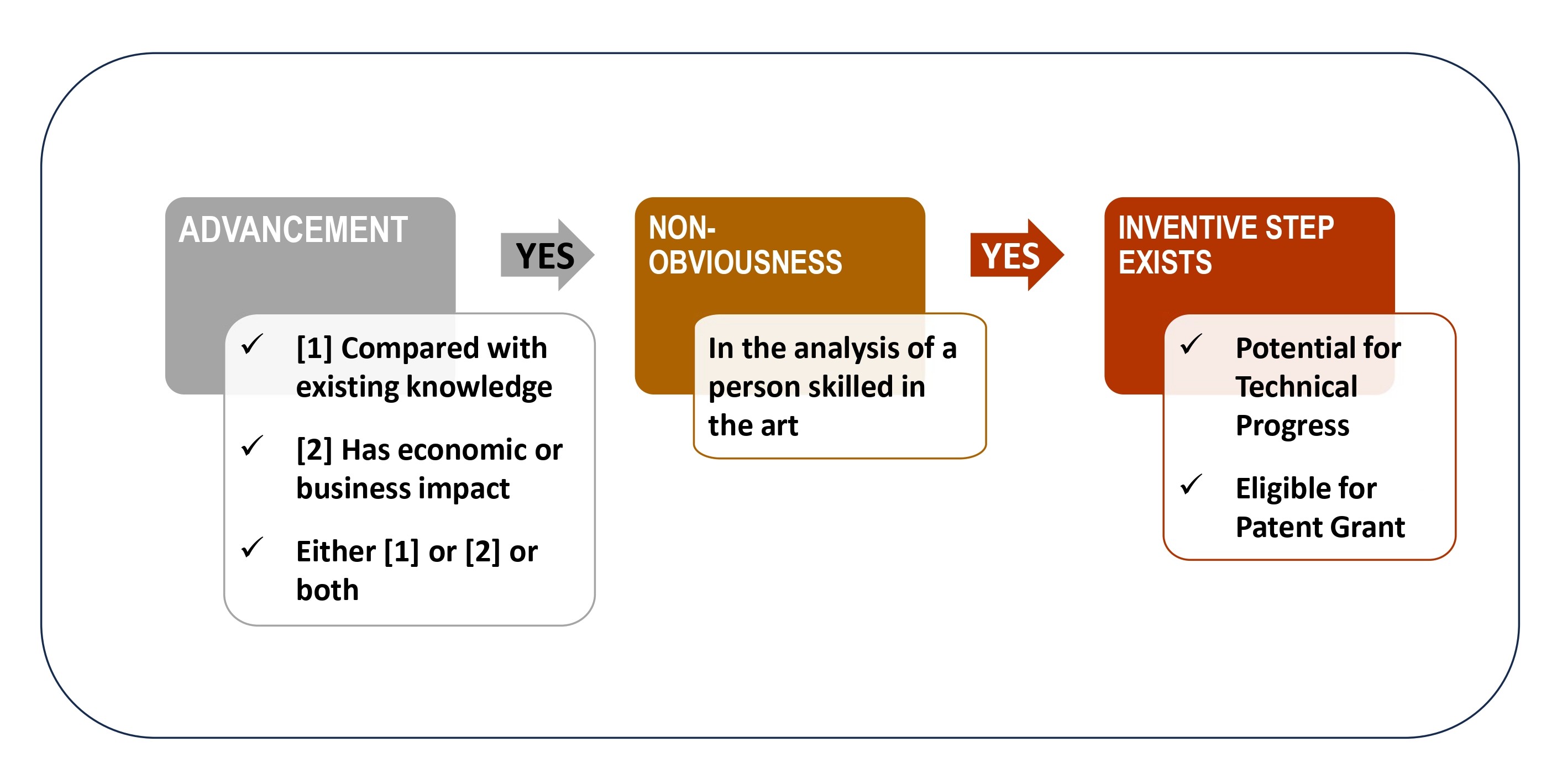
‘Inventiveness’ implies the invention has a novel and original aspect or attribute, feature or function. This means it: (a) incorporates an advancement either vis-à-vis existing knowledge or having economic significance or both; and, (ii) makes the invention not obvious to a person skilled in the art.
Inventiveness is ascertained based on whether the claimed invention, taken in its entirety, already exists in state of art. It is not sufficient to conclude that the invention is obvious because individual parts of the claims taken separately are known in prior art or may be deemed to be obvious.
It is noteworthy that if an invention merely verifies prior knowledge, without substantially altering either technical function or economic significance in the art, then it lacks the ‘inventive step.’ Further, if the invention is apparent based on existing prior art and only requires workshop improvement by a person skilled in the art, then such invention lacks the inventive step and is deemed to be obvious. Patent applicants must provide detailed evidence of non-obviousness, which often requires robust technical and economic arguments.
While ‘inventiveness’ refers to the inherent originality of an idea, it is distinct from the legal standard or statutory requirement of ‘inventive step’. In simpler terms, inventiveness is the raw creative impulse, while the inventive step is the filter that determines whether this impulse constitutes a legally protectable invention.
For instance, if an inventor creates a new type of water filtration system that uses a unique combination of natural materials to remove contaminants more effectively than existing systems, the concept shows inventiveness. If this combination offers significant cost saving or produces measurable technical improvement, it satisfies the inventive step requirement too.
Conversely, inventiveness may exist, despite the absence an inventive step. A novel, artistic pattern on the casing of a water filter might be creative and original. Yet, it has no ‘inventive step,’ if it does not improve the system’s performance or provide tangible economic value. Similarly, the cosmetic change of altering color or shape of an existing product, without affecting its function, lacks both inventiveness and an inventive step.
At Blaze Ventures, we have qualified professionals and elaborate processes for ascertaining ‘inventiveness’ or ‘non-obviousness’ of ideas, innovations and inventions.