The process of searching patent databases requires a combination of strategic keyword selection, legal knowledge, systematic interpretation of claims and technical understanding of the invention. Patent databases, online knowledge repositories and offline resources are searched for many purposes; it includes checking to ascertain novelty of an invention; monitor competitors; avoid infringement; and, identify technological trends.
Patent database search entails a structured process of defining the invention effectively; meticulously choosing the right tools; and, using specific search strategies to find relevant prior art.
The first step in the process is to determine the reason for the prior art search. Typically, it is carried out to determine patentability and contemporaneously while drafting patent claims. It is also done for challenging a granted patent.
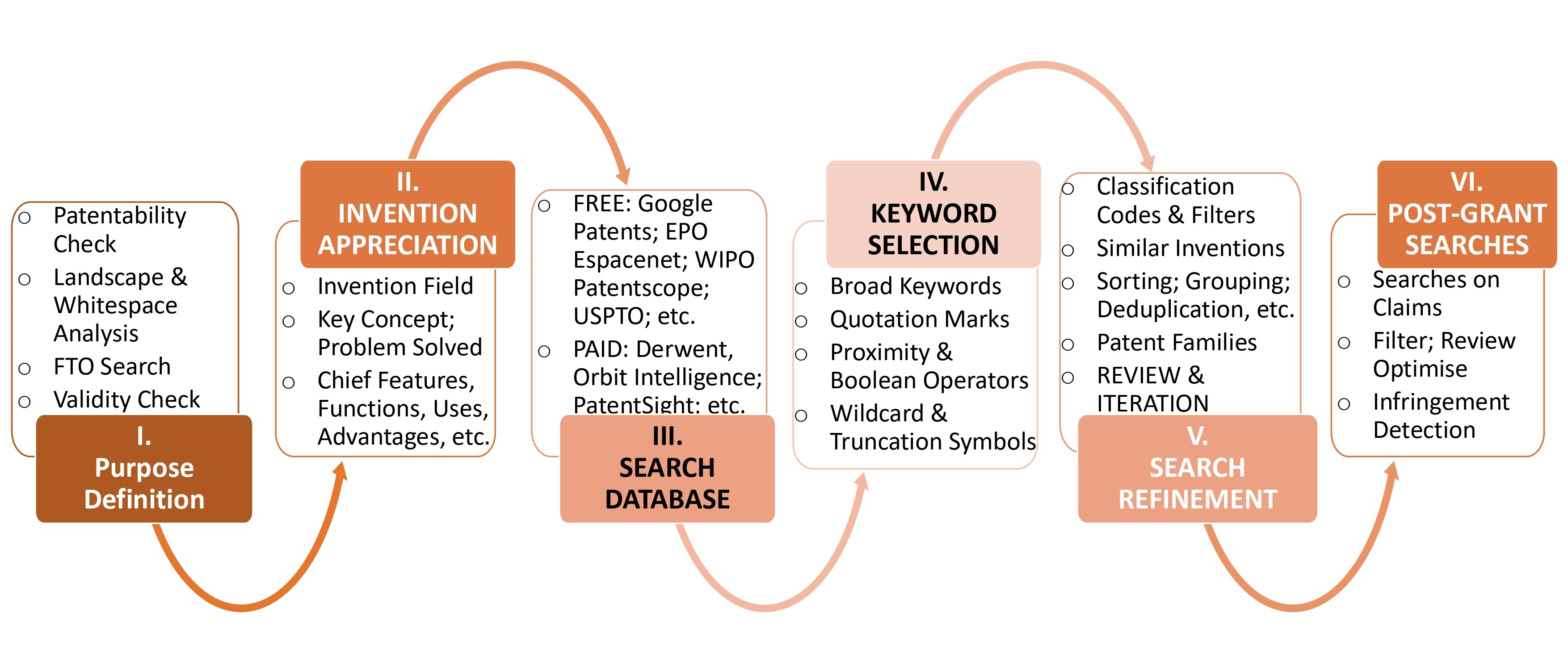
Common objectives include: (i) assessing novelty and patentability of an invention (patentability check); (ii) reviewing technical advances and functional enhancements in a specific field (landscape analysis); (iii) identifying potential opportunities for innovation in the technical landscape (whitespace analysis); (iv) evaluating the likelihood of infringing existing patents (freedom-to-operate search);and, (v) examining prior art that could challenge a specific patent (validity search).
Therefore, the search strategy differs depending on the objective.
A core tenet of intellectual property law, as enunciated in the landmark case of Peters v. Active Mfg. Co.[1] adjudicated by the US Supreme Court, is: "that which infringes, if later, would anticipate, if earlier."
For any prior art search, itis vital to precisely understand the invention—this encompasses identifying the field of invention; understanding its essential concepts; defining the specific problem that the invention solves; and, listing the key features, functions, working details, steps or components, uses, and, advantages thereof.
It is equally crucial too to extract keywords; identify relevant technical terms and jargon; synonyms therefor; and, alternative names for features from a description of the invention.
Patent documents often use unusual or broad language; hence, identifying synonyms is critical. For instance, “drone delivery systems” are often described as unmanned aerial vehicle (UAV) delivery platforms; autonomous aerial logistics systems; unmanned aircraft transport systems, and, so on.
Numerous free patent databases are available. They include:(a) Google Patents, which is best for quick, user-friendly, keyword-driven global searches; (b) Espacenet, run by the European Patent Office (EPO), it is ideal for international data; (c) WIPO Patentscope, which is ideal for searching international applications filed under the Patent Cooperation Treaty (PCT); (d) USPTO Patent Center—the official US patents’ repository; (e) IP India Patent Search System, for search in India; and, so on.

Commercial databases, such as, Derwent Innovation, Orbit Intelligence, and LexisNexis PatentSight provide more advanced analytics.
It is advisable to start with broad keywords—for example, “plasma seed treatment”, “textured vegetable protein (TVP)-based meat clone”, “vertical farming system”, and, so on—and gradually narrow the search. The quotation marks are used to search on phrases.
Boolean operators—AND to connect different concepts; OR for synonyms; and, NOT to exclude irrelevant terms— are extremely useful for refining searches. If the database supports it, proximity operators of NEAR and SAME are also invaluable search commands for finding words close to each other.
Similarly, wildcards and truncation symbols, such as asterisks (*), help in expanding the search to include variations of the defined keywords. For instance, the string “electric*” helps search for variations of ‘electric’, such as ‘electricity’ and ‘electrical’.
Thus, it is evident that the search process is dependent on how ‘the invention’ is envisaged. In general, itis preferable to have several keywords that encapsulate the basic idea of the invention and use them in combination to search prior art. Ideally, the invention should be framed as a single sentence.
Patent classification systems are extremely critical because patents may use terminologies that have multiple technical, context-sensitive connotations. Hence, patents are categorized in databases by technology (or technical field) too. The major patent classifications systems are the IPC (International Patent Classification) and CPC (Cooperative Patent Classification) systems.
For instance, ‘bandwidth’ refers to the ‘amount of data transmitted over a network’ in technology’ and ‘a person’s mental capacity’ in psychology. Similarly, an “agricultural seed-treatment” invention may be categorized under agriculture, biotechnology, or plasma processing.
Searching for keywords strictly within relevant IPC and CPC codes filters out unrelated patents and yields more accurate results, as compared with keywords alone.
The search results can be narrowed down further with the filters—they include assignee, inventor, priority dates, etc.— that most patent database search engines provide. Some databases, such as Google Patents, provide a “similar button”, which can be clicked to retrieve patents similar to the one selected.
Search results can also be:(a) sorted using various criteria, such as, relevance, newest, oldest, etc.; (b) grouped by patent classification; and, (c) deduplicated by either patent family (it prevents a query from returning several identical filings across different geographies) or publication (this displays inventions based only on first officially-published and unique records thereof, while hiding identical copies or localized regional versions; etc.).
The titles and abstracts of retrieved patents are reviewed briefly to weed out irrelevant inventions quickly. Once a relevant patent is found, it is examined in greater detail. Earlier documents cited in (backward citations) and newer/later filings that cite (forward citations) such scrutinized patents are looked at too.
Tracking the patent filings of top inventors or companies working in the same technology space is recommended; patent family members filed in different countries are to be examined too. Use of the “Similar Patents” option on Google Patents also helps identify related inventions.
This review of citations and patent families helps in tracing technological evolution over time.
It is vital to remember that claims define the legal scope of protection. The claims (and not just the title or abstract) in the closest patent must be examined diligently too in prior art searches. A patent may appear similar technically but differ legally because of claim wording.
Patent searches are typically iterative. Initial results often reveal further aspects pertinent to the invention, such as, new terminology, relevant inventors, competitor companies, additional classifications, etc.
Based on such additional information discovered, the search strategy may be suitably refined also. It is always advisable to maintain meticulous search records of keywords and classification codes used in searches; patent databases scanned; and relevant documents and patent filings retrieved and reviewed.
Such records improve consistency and avoid duplication of efforts.
Once the search process is complete, and the closest prior art identified, the next step is to identify the functional differences between the invention in question and the prior art. This is the delta (“Δ”), that is, the incremental, inventive step between our invention and the prior art.
Prior art searches for post-grant patent challenges require a somewhat tweaked strategy. The focus shifts away from keywords; the gamut of claims in the challenged patent are relied upon for search and results are generated till the priority date of such patent.
Each claim is taken separately and converted into a sequence of keywords by removing adjectival, prepositional, conjunctional and certain other action or state words, such as, “the, of, an, comprising, comprised, etc.” Further, the prior art search is restricted upto and until the priority date of the invention on challenge.
The search process has to be iteratively optimised, filtered and reviewed to get suitable results and to gain insights on infringement. Needless to say, the use of classification codes ensures relevancy of search and review.
Often complex searches, in particular freedom-to-operate(FTO) and invalidity searches in high-stakes scenarios, are performed by patent attorneys or professional patent search firms, who can be expensive. This is because incomplete or erroneous searches can have serious legal, competitive and commercial consequences.
.png)
Artificial Intelligence (AI) tools too are available for automated patent database and prior art searches. EDISON, Blaze Ventures’ proprietary infringement detection and patent database search software, uses agentic-AI and generative-AI for iteratively and interactively carrying out searches. EDISON even provides confidence levels for each of the search results.
Patent database searching is a technical and analytical exercise. Effective search requires an insightful understanding of the invention; mastering the art of keyword selection and classifications; and then, carefully analysing patent documents and claims. Patent database searching is an essential skill for inventors, researchers, attorneys, and businesses engaged in innovation, specifically IP protection.
At BLAZE VENTURES, we have qualified professionals and elaborate processes to help inventors and enterprises create and protect sustainable IP assets in the many fields and to monetise them effectively. Our AI-based software, EDISON is always used to enhance the quality, efficiency and reliability of patent database searches.
______
[1] 130 U.S. 626 (1889)