Restrictions are formal, procedural requirements issued by a patent office. They uphold the purpose of the patent system by ensuring that only genuine, useful, and socially acceptable inventions are approved for patent protection. Hence, they foster innovation and safeguard product development activities without compromising on public interest.
Applicable restrictions pertain to both procedural and substantive elements. The restrictions are obviously based on specific regulations and standard practices of patent offices.
Referred to as “restrictions by exception”, certain subject matters are expressly excluded from patent grants. Not all inventions qualify for patent protection. Patent applications for such restricted inventions are rejected outright.
Such restricted inventions vary for each jurisdiction. In general, abstract ideas, frivolous inventions, laws of nature (or, mere natural discoveries), mathematical methods, computer programs per se and physical phenomena are not patentable. In some jurisdictions, methods of medical treatment, and certain biological processes are restricted from patentability.
Thus, the prerequisites of novelty, inventive step (or non-obviousness), and utility (or industrial applicability) are the primary acceptance criteria for patentability, besides sufficiency of disclosure that is enabling.
Contrarily non-patentable subject matters constitute the grounds for rejection.
In most countries, unity of invention―the condition that a patent application must relate to either a single invention or a group of inventions forming a unitary inventive concept―is a key procedural requirement.
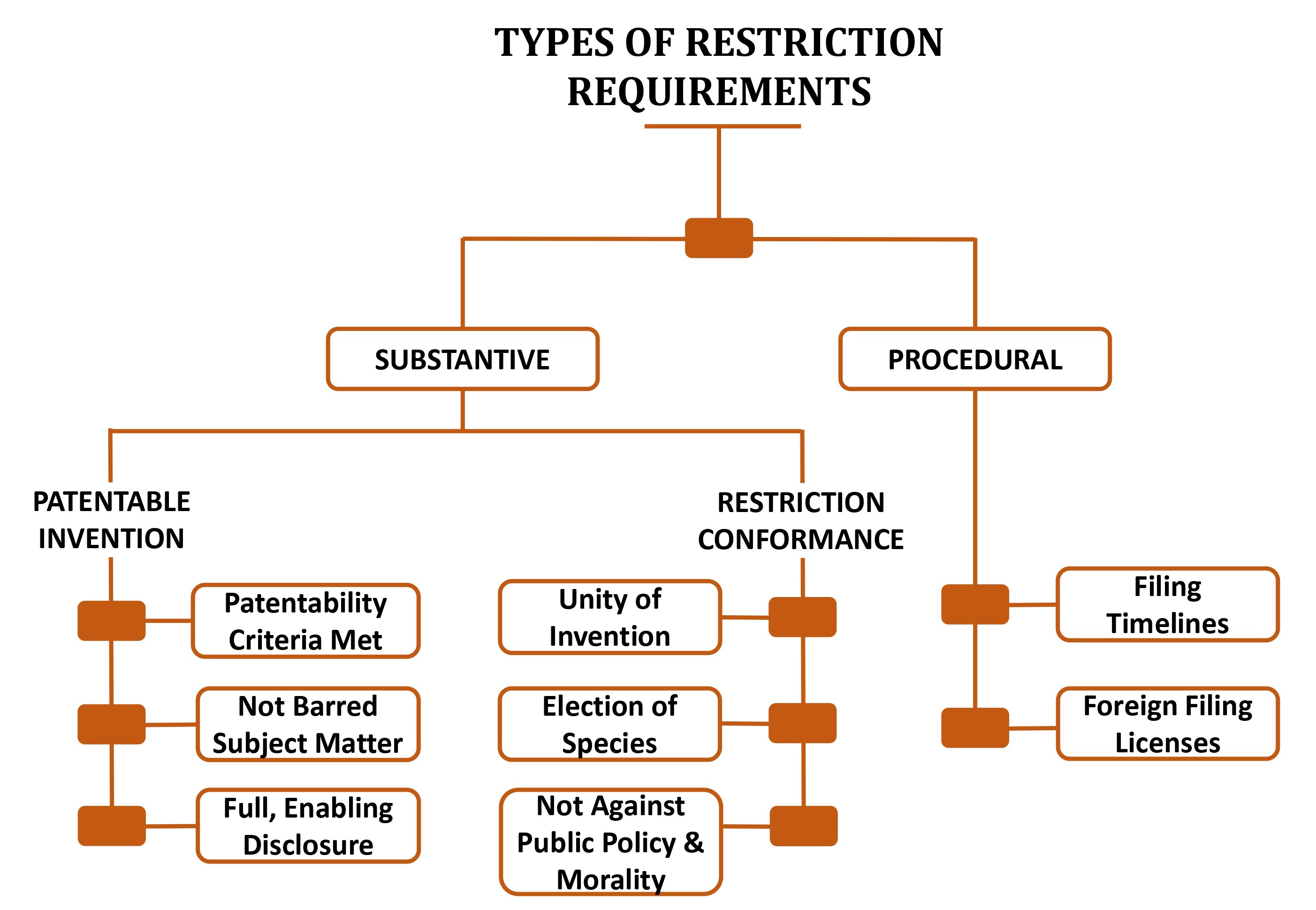
There are restrictions too based on public policy and morality. Inventions that are against public interest or are harmful to society― such as, those either contrary to ethical standards or related to criminal activities― are also typically excluded from patentability.
Hence, if an application comprises of a multiplicity of distinct, but unrelated inventions, the examiner may require the applicant to pick any one invention to pursue in that application. Similarly, when a generic claim (genus) in the application covers multiple variants (species) of an invention, the patent office may require the applicant to elect one specific embodiment, that is, species for examination.
Alternatively, when such a restriction requirement is issued, the applicant can contend that the inventions are not truly distinct and that they should be examined together. Despite traversal of or challenge to such restriction, a provisional election is still mandatory. The non-elected inventions can be pursued separately as ‘divisional applications,’ which crucially preserves the original filing date and priority for the claims.
Strict deadlines too exist for filing a request for examination. Depending on the jurisdiction, these are typically 31-48 months. Inventors in some jurisdictions (such as, India) must obtain a foreign filing license before filing a patent application outside the country if the invention was made in that country.
Further, there is no strict enforcement of any limit on the number of claims; however, incorporating excessive claims (>10) in the application typically results in additional filing & processing fees being incurred.
In conclusion, restrictions play a crucial role in the patenting procedure. They ensure that patent rights are granted only to inventions that meet established legal standards. Besides helping streamline examination practices, restrictions impede the practice of double patenting too. They are designed to maintain a balance between encouraging innovation and preventing undue or broad monopolies over technical know-how.
At BLAZE VENTURES, we have elaborate processes and qualified professionals for helping inventors and enterprises with the comprehensive protection of IP rights over their ideas, inventions and innovations in cross-border jurisdictions.