A combination patent protects an invention that comprises a novel merger, arrangement or combination of pre-existing, well-known elements or components. When such elements/components are combined, assembled or operated together, they must produce a new and useful result.
Therefore, unlike patents that claim completely new products or processes, combination patents recognize that novelty also lies in the innovative arrangement, combination or interaction of existing products, processes, and technologies.
The patentability of such inventions depends not on the novelty of each individual element, but on whether the combination as a whole is new, involves an inventive step (non-obviousness), and is capable of industrial application.
Therefore, to successfully secure protection, a combination invention must meet several criteria:
Thus, it is clear that a key challenges of obtaining a combination patent is demonstrating that the invention is not a mere aggregation of known parts. If each element independently performs just its conventional function, the claimed invention may be rejected as obvious.
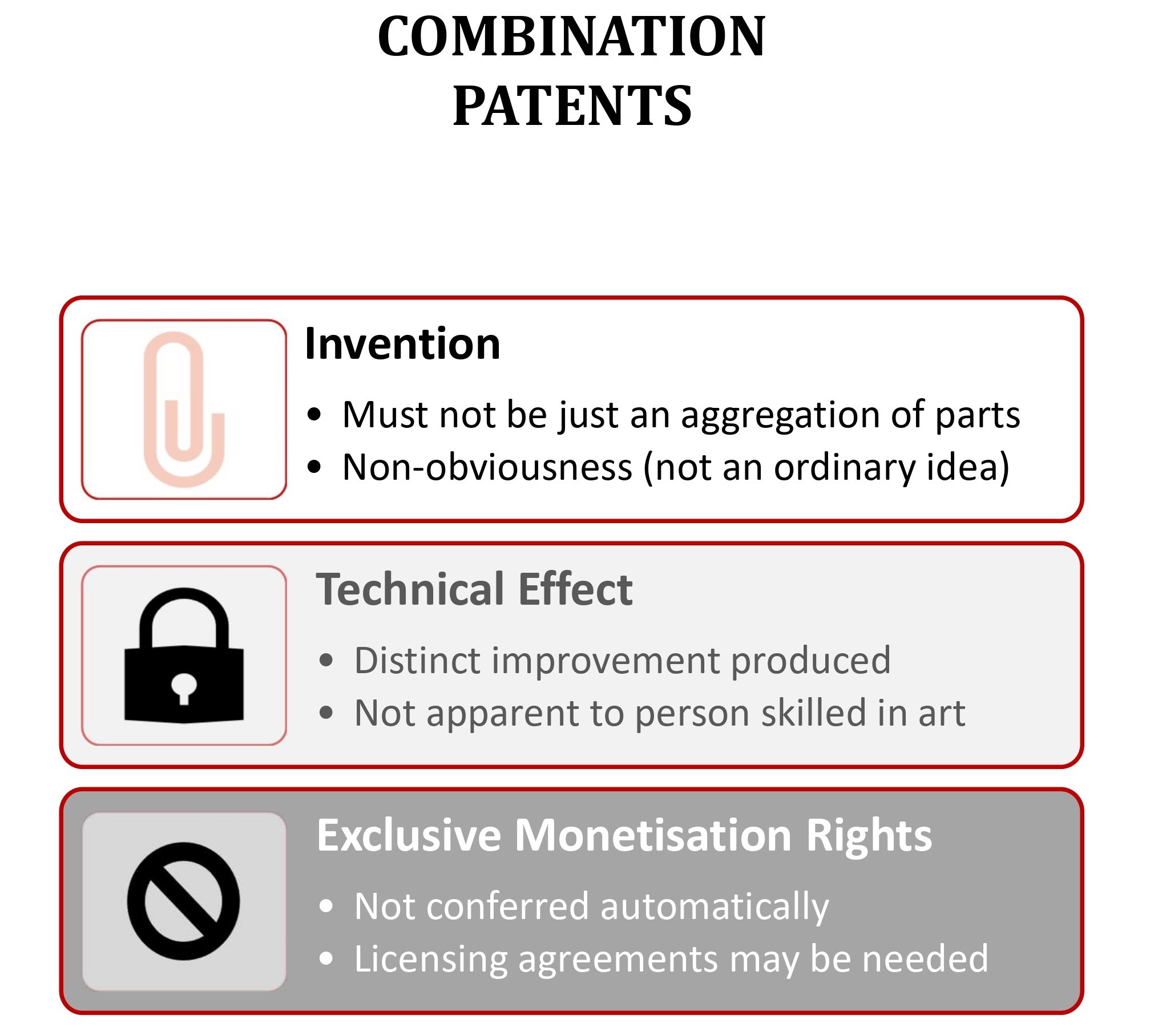
Hence, applicants must clearly describe the technical effect or improvement produced by the combination. Besides, the technical contribution achieved must be not apparent to a person skilled in the art.
Further, even if a combination patent is granted, the exclusive right to market, manufacture, or otherwise monetise the invention freely may not get automatically conferred on the patentee. Licensing agreements from the original inventors of the constituent parts, which are still under the protection of valid patents, may be a necessary prerequisite for the commercial exploitation of the new, patented combination.
Filing of applications to obtain combination patents is common in the fields of electronics, mechanical engineering, pharmaceuticals, computer technology, and software engineering.
For instance, an inhaler that incorporates a new mechanism for dispensing an existing medication into the human body is potentially eligible for a combination patent. So too, a pharmaceutical formulation that combines known active ingredients to enhance therapeutic effects or reduce side effects.
Similarly, an adjustable car foot-pedal integrated with an electronic sensor for regulating acceleration perhaps may be patentable too.
Combination patents play a vital role in nurturing innovation by encouraging inventors to integrate known parts and elements in inventive ways to add functions, solve problems, improve products, enhance performance, and so on.
However, patent examiners and courts scrutinize such innovations strictly for ensuring that exclusive rights are granted only to genuinely inventive combinations. This rigorousness fosters economic and technological progress, while preventing undue monopolization of obvious and ordinary design or engineering ideas.
At BLAZE VENTURES, we have elaborate processes and qualified professionals for advising inventors and enterprises strategically on the effective creation, protection and commercial exploitation of IP rights over their ideas, innovations and inventions in multiple jurisdictions.