Patent revocation is the legal process of cancellation of a granted patent, either wholly or partially prior to the expiry of its term. Patents are often revoked when they fail to meet statutory requirements. It erases the patentee's intellectual property in the invention and the exclusive rights thereon. As a consequence, the invention becomes freely available to the general public.
Revocation ensures that patents are granted only for inventions that satisfy the statutory requirements of patentability; further, it also helps prevent the creation of unjust monopolies based on the granted patent in contravention of public interest.
It is pertinent to note that while a surrender of patents is voluntary; a patent revocation is an involuntary cancellation, generally based on a court order or an application filed by a third party on the grounds that the patent was wrongfully granted, lacked novelty, or violated other legal requirements. However, both revocation and surrender result in the annulment of the patent rights.
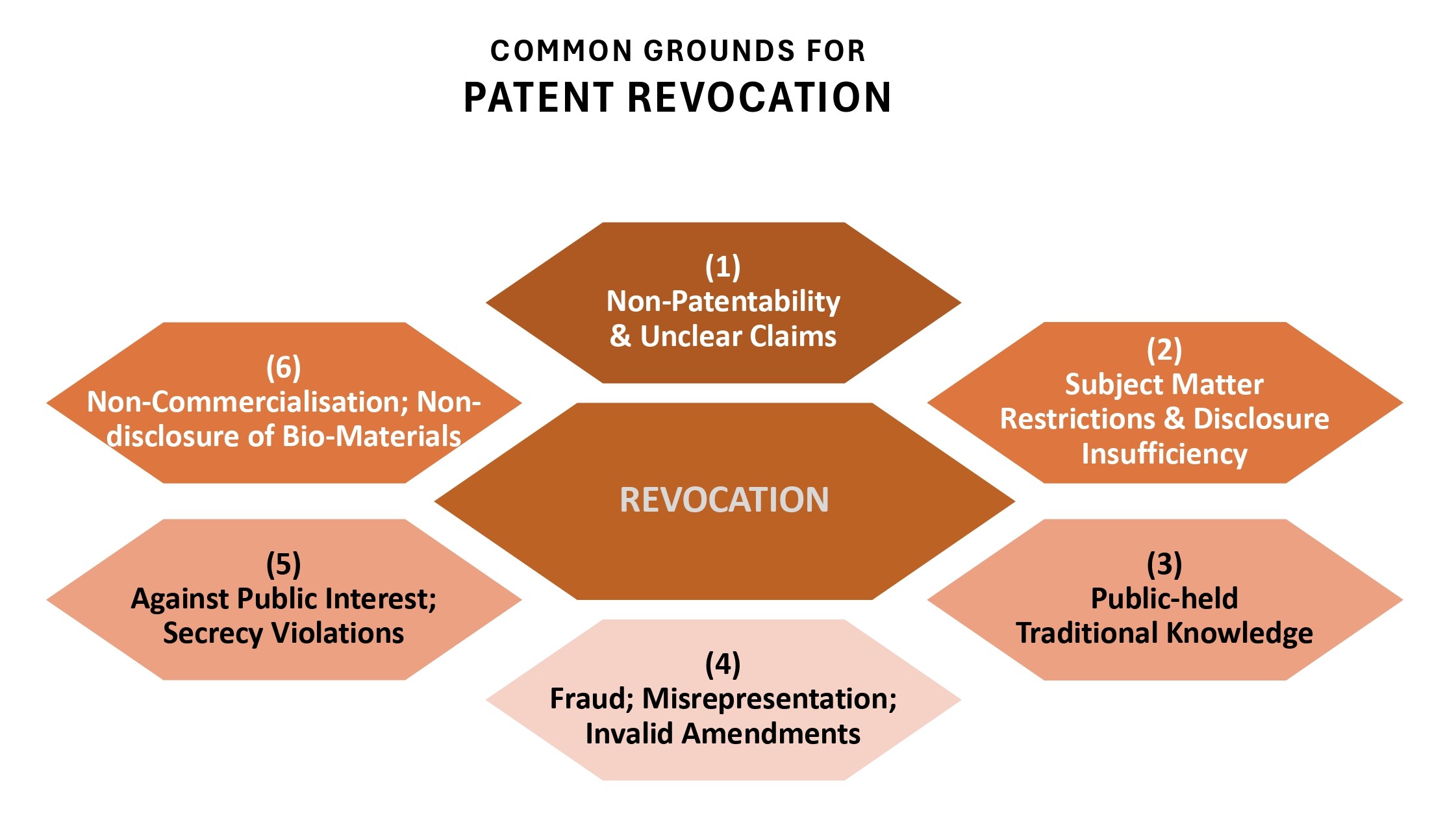
A patent may be revoked on several grounds, such as:
Besides the above key grounds, a patent may be also revoked if: (i) its claims are unclear and not fairly based on disclosed material; (ii) the invention is derived from publicly known traditional knowledge with insufficient innovativeness; (iii) it is non-compliant with governmental secrecy directions or requirements; (iv) it omits or discloses inadequately the use of biological materials; and, (v) it has invalid or fraudulent amendments.
A petition for revoking any patent may be filed before the appropriate court by any interested person (such as, affected individuals, competing businesses, or consumer advocacy groups); or, suo motu by the concerned Government or any competent authority.
Additionally, a defendant in a patent infringement lawsuit may also make a counterclaim for revocation. The court then reviews the evidence and determines whether any of the statutory grounds available for revocation has been proven by such contesting defendant.
Once a patent is revoked, the patentee loses the exclusive rights conferred on the invention, which then generally enters the public domain unless protected by other IP rights. Consequently, revocation may affect ongoing licensing agreements and infringement litigation too.
Revocation serves as an important mechanism for balancing the interests of patentees with those of competitors and the public at large. Revocations promote fair competition, by not only preventing the enforcement of invalid patents, but also ensuring that only genuine inventions that meet legal standards get patent protection. This fosters innovation, competition, and public welfare.
Revocation proceedings act as an essential safeguard too by preserving the integrity of the patent system. Besides, the possibility of revocation forces patent applicants to draft accurate specifications and conduct thorough prior-art searches before filing applications.
At BLAZE VENTURES, we have elaborate processes and qualified professionals for helping inventors and enterprises to not only navigate through, but also avoid the initiation of revocation proceedings.