Licensing is a preferred approach for monetisation of patents. It is a legal and commercial mechanism through which a patent owner (licensor) accords permission to another party (licensee) to use, make, sell, distribute, or otherwise exploit a patented invention in exchange for payments, usually royalties.
In licensing, licensors enter into contractual agreements with licensees under specific terms and conditions, such as, duration, territory, exclusivity and scope. This allows both parties to profit from the innovation while the licensor retains ownership of the patent. Thus, the owner generates revenues without either manufacturing the invention or relinquishing ownership thereof.
Licensing plays a focal role in the commercialization of intellectual property. It essentially balances exclusivity and access. It enables innovative ideas to reach the marketplace without requiring the patent holder, who has exclusive rights over the patented invention, to manufacture, sell or distribute the invention directly.
Patent licensing serves several vital economic and strategic functions. It allows patent rights to be shared in a controlled manner. For licensors, it provides a means to monetize patent rights, generate recurring revenues, recover R&D costs, and, earn a return on investment, particularly when they lack the capacity to commercialize the invention themselves.
For licensees too, it mitigates the risks and reduces the costs associated with innovation. It also provides access to proven technology, enables faster market entry and gives the freedom to operate. Licensing is also a major aspect of technology transfer and driver of innovations, facilitating the diffusion of innovations from research institutions, universities, and startups to established businesses.
The choice of license structure depends on business strategy, market size, and the nature of the technology. Licenses may be either: (a) exclusive, wherein only a single licensee is granted rights, often even to the exclusion of the licensor; or, (b) non-exclusive, wherein multiple licensees can operate simultaneously.
Some agreements may confer the right of sub-licensing to the licensees. In other scenarios, patentees may enter into cross-licensing arrangements, wherein licenses for monetising each other’s inventions are exchanged. In sole licensing, both the licensee and licensor retain the right to use and exploit the invention.
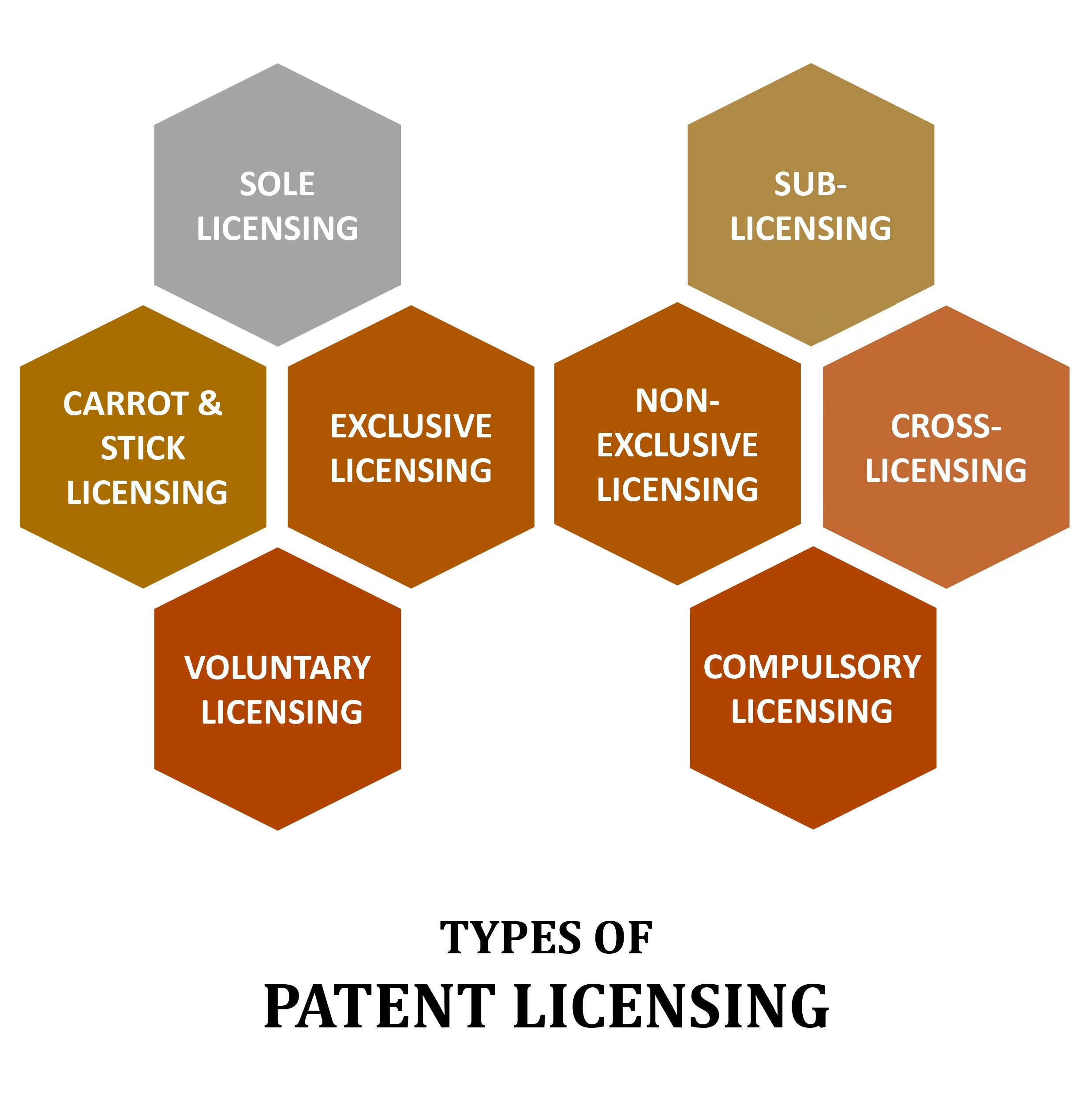
Compulsory licensing allows a government to authorize a third party to use patented inventions, such as essential medicines, typically for public benefit without the owner's consent. By paying the owner a reasonable royalty for the patent, it prioritises public access, thereby balancing patent rights with public interest.
Voluntary licensing (VL) entails a contractual agreement where a patent owner, such as, a pharmaceutical company, grants a third party, say, a generic producer, permission willingly to use their invention to produce, import, and/or distribute its patented invention under specific terms. This method benefits both the patentee-licensor and the licensee, by giving the former access to expanding or emerging markets and creating revenue streams while avoiding government intervention.
Carrot licensing uses incentives, such as, attractive royalties, collaborative engagements, to attract licensees and forge partnerships focusing on mutual benefit. Contrarily, stick licensing relies on threats of litigation against existing infringers, forcing them to either license or face lawsuits.
Patent licensing is a vital bridge between invention and commercial exploitation thereof, aligning legal rights with business realities. In general, contracting parties are free to decide the scope and extent of mutual obligations in licensing agreements. Courts only enforce the terms, conditions and mutual covenants included therein.
Licensing agreements typically specify the scope of the license, including the territory, duration, field of use, and permitted activities. They also define financial terms, most commonly in the form of royalties. In addition, mutual covenants, such as, sub-licensing rights, performance obligations, confidentiality, quality control and reporting requirements, are also incorporated.
From a legal perspective, patent licensing must comply with competition and antitrust laws. Certain licensing practices—such as price fixing, market allocation, or unreasonable restraints on trade—may attract regulatory scrutiny. Several judicial forums have repeatedly emphasized that while patent rights are exclusive, their exercise through licensing should not distort competition or extend the patent monopoly beyond its lawful scope.
At Blaze Ventures, we have elaborate processes and qualified professionals to strategically advise inventors and enterprises on licensing agreements for patented inventions.