Royalty stacking refers to multiple royalty and license fee payments that a manufacturer or licensee has to make when a single product or process incorporates several patented inventions and technologies owned by different patentees. This not only causes the royalty fee payments to snowball, but also may often result in a cumulative licensing burden that is prohibitively high.
The economic impact of royalty stacking is a major impediment for licensee-manufacturers wanting to launch products incorporating numerous third-party patents, particularly when each licensor stipulates a complex and distinctly different license fee structure. Such aggregate royalty obligations can not only increase the overall product cost significantly, but also inflate the total investment for “go-to-market” substantially and delay breakeven inordinately.
Royalty stacking is a primary concern in the monetisation of products, which are based on complex manufacturing processes, cutting-edge technologies and the use of multiple patented inventions.
This phenomenon is commonly witnessed in industries, such as, telecommunications, consumer electronics, semiconductors, biotechnology, and pharmaceuticals, where complex products often implement multiple standards; and, rely on hundreds or even thousands patented inventions, enabling technologies, delivery systems and proprietary intellectual assets owned by third-parties.
Royalty stacking is particularly relevant in the case of SEPs (Standard-Essential Patents), where manufacturers must obtain licences from multiple patent owners to comply with applicable industry standards. To resolve challenges that this issue poses, many standard-setting organizations mandatorily require SEP-holders to license their patents on Fair, Reasonable, and Non-Discriminatory (FRAND) terms.
Courts in several countries and jurisdictions have recognized the potential risks, besides the grave dangers, associated with stacking of royalties, while adjudicating matters in patent infringement and licensing disputes.
The main concern with royalty stacking is that despite individual royalty rates seemingly being reasonable, cumulative effect may become excessive, thereby: (i) increasing production costs; (ii) driving up retail prices of products; (iii) eroding profit margins; (iv) reducing profitability of products; (v) making product development commercially unviable; and hence, (vi) discouraging innovation.
Thus, the cumulative effect of stacking can deter firms from developing and launching new products, particularly startups and small enterprises with limited financial resources. Consumers may be adversely affected too through higher prices and reduced product availability options.
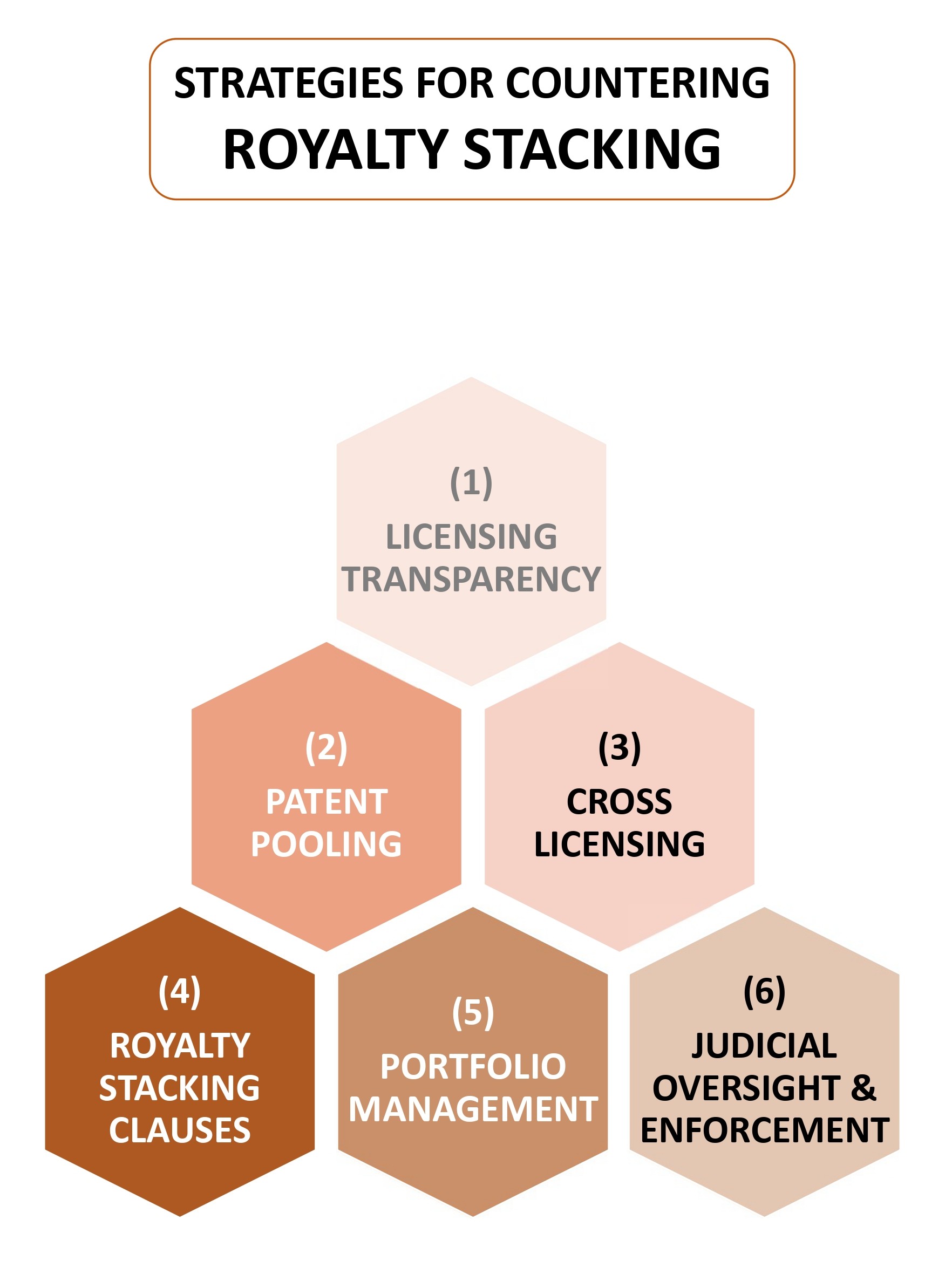
Businesses adopt various strategies to mitigate royalty stacking risks.
Patent pools allow multiple patent owners to collectively license their patents through a single agreement, which simplifies negotiations and reduces transaction costs. Cross-licensing arrangements between enterprises can also reduce the need for multiple royalty payments.
Express royalty-stacking clauses are often included in contracts to prevent licensees from paying exorbitant royalties. Such clauses state that if the licensee is later forced into taking out additional licenses from third parties, then the licensee is entitled to proportionately reduce the royalty payments to the primary licensor.
Further, meticulous patent portfolio management, transparent licensing practices, and judicial oversight of SEPs and FRAND obligations help ensure reasonableness of cumulative royalty payouts.
It is pertinent to note that royalty stacking is not inevitable; it is not a universal phenomenon that impacts every technology sector. Commercial negotiations, patent validity challenges and revocations; availability of alternate technologies; market forces and competition; etc., all constrain excessive royalty demands.
Nevertheless, royalty stacking is a critical aspect of patent law and technology licensing. Adequately rewarding patent holders, without jeopardising affordable access to technology is essential for promoting innovation, competition, and economic and industrial progress.
At BLAZEVENTURES, we have elaborate processes and qualified professionals for advising inventors and enterprises strategically on the effective creation, protection and commercial exploitation of IP rights over their ideas, innovations and inventions in multiple jurisdictions.