Patent laws in several jurisdictions provide for the accelerated processing of applications for patents. This expedited procedural mechanism allows applicants to obtain faster examination and grant of their patent applications as juxtaposed with ordinary timelines.
These expedited patent application processing programs are designed to nurture innovation, encourage rapid commercialization, and also provide early legal certainty on patentability in fast-moving technology sectors.
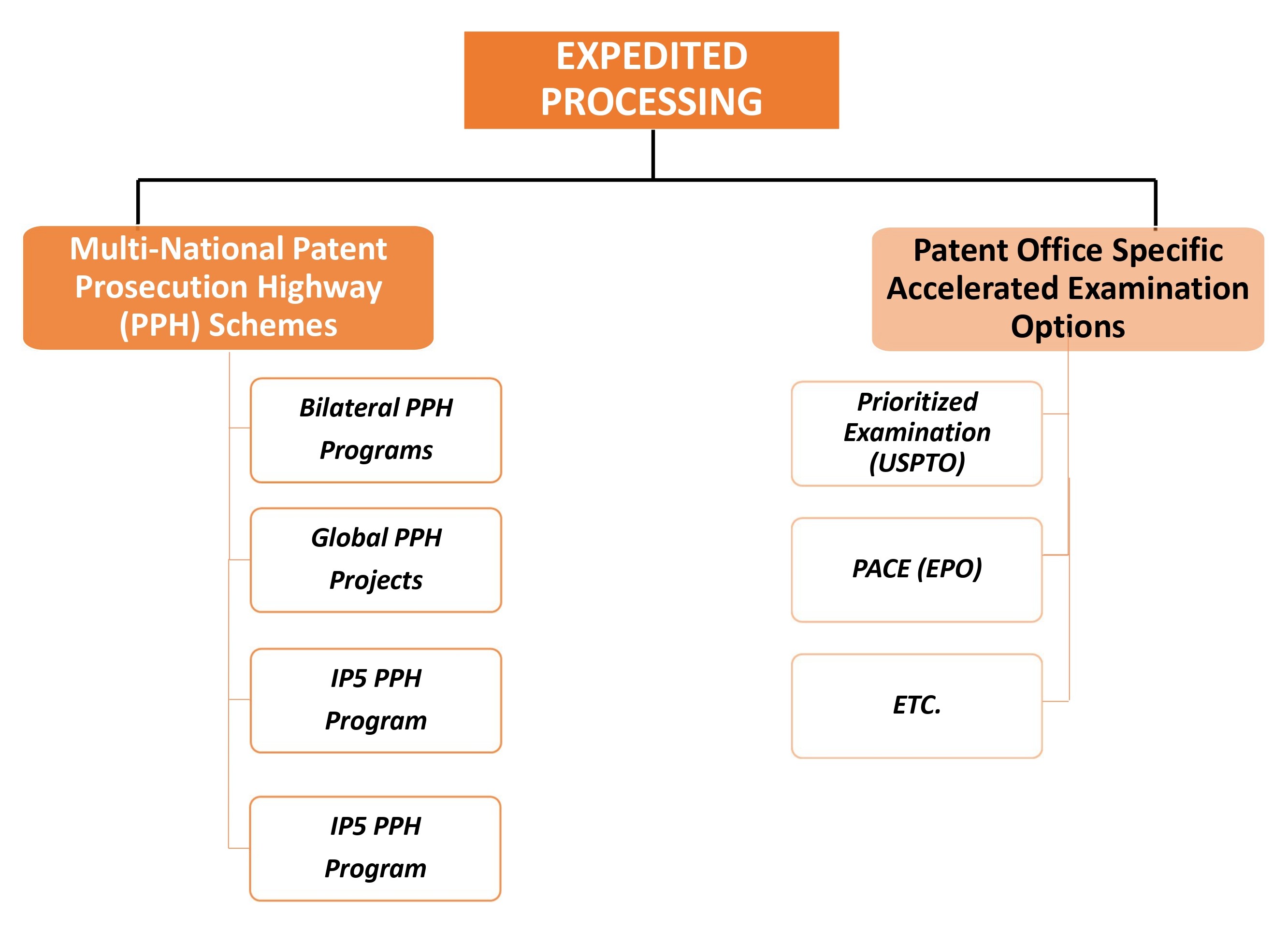
Globally, major patent offices have implemented well-defined and documented accelerated application processing schemes. For example, the Patent Prosecution Highway (PPH) programs enable the fast-tracking of examination in one jurisdiction based on favourable examination results in another.
This cooperative framework operates across multiple jurisdictions, such as, the United States Patent and Trademark Office; Japan Patent Office; and, European Patent Office. Under the PPH, applications benefit from reduced examination time, lower examination workload, and. higher grant rates.
Numerous types of PPH frameworks exist, such as: (a) Bilateral PPH, which are between two patent offices; (b) Global PPH, which is a cooperation project among26 patent offices worldwide; (c) IP5 PPH, which extends to USA, Japan, Korea, Europe, and China, as its members; and, (d) PPH Mottainai, a pilot scheme.
Besides PPH, national patent offices too offer independent fast-track options. For instance, the USPTO offers, upon payment of an additional fee, Track One Prioritized Examination, which enables applicants to receive a final disposition—allowance or rejection—typically within 12 months.
Other offices, such as, the Japan Patent Office, Indian Patent Office, etc., offer accelerated examination for startups, women, green technologies, and, so on. The EPO too has implemented the PACE (Program for Accelerated Prosecution of European Patent Applications) system for voluntary acceleration. Such expedited processing is available to eligible applicants and inventors on payment of extra fees.
Expedited processing is particularly valuable and procedurally preferable for patenting inventions in the fields, such as, artificial intelligence (AI), clean energy, pharmaceuticals, telecommunications, etc., where product lifecycles are short, technological obsolescence is fast and early enforcement rights are crucial for investor confidence. Faster grants enable quicker monetisation too of patents, through licensing, early venture funding, strategic market entry, etc.
Such acceleration, though, comes with a downside— that of procedural overhead and strategic trade-offs. Examiners operate under compressed timelines, which can result in stricter (or worse, poorer) scrutiny and increased office actions. Applicants must ensure high-quality drafting of claims, adequate disclosure, and thorough prior-art analysis before entering fast-track programs. On top, expedited routes frequently entail higher official fees and limits on claim numbers.
From a policy and governance perspective, fast-track examination balances two competing goals—response time and quality of scrutiny. While it catalyses innovation and economic activity, patent offices must guard against the risk of granting weak or overly broad patents due the reduction in examination time.
To summarize, expedited patent processing is a vital aspect of the global patent ecosystem; it has reshaped traditional pre- and post-grant prosecution strategies. By virtue of international cooperation frameworks and local prioritization schemes, applicants can obtain enforceable patent rights quicker.
At BLAZE VENTURES, we have elaborate processes and qualified professionals to advise inventors and enterprises on rapid patent grants for their ideas, inventions and innovations via expedited, fast-tracked processing channels and schemes.