Freedom to Operate (FTO) Analysis is a legal and commercial assessment done to determine whether a product, process, service, or technology can be commercially exploited (by way of sale, marketing, development or manufacture) without infringing valid patent, design or utility model rights of third parties in target jurisdictions.
A FTO analysis is an IP risk assessment exercise, which is an essential component of innovation management, particularly in cutting-edge areas of fields, such as, software, electronics, robotics, engineering, pharmaceuticals, and biotechnology, where patent protection plays a significant role.
A company may own a valid patent for its invention in one jurisdiction; and, still infringe another party’s patent rights in another jurisdiction. Hence, the purposes of a FTO assessment are to: (i) identify relevant patents; (ii) analyse claims therein against the proposed commercial activity; and, (iii) provide an opinion on the likelihood of infringement.
It is obvious that a FTO examination helps identify potential risks of patent infringement before substantial capital and revenue expenditures are incurred on manufacturing facilities, distribution networks, production scaleup, product launch, market entry, M&A, etc.
The analysis helps in the ascertainment of IP infringement risks. It is useful for determining whether it is prudent to delay the product launch; or, introduce in the product a design workaround for the competitor’s patent; or, negotiate a license with the concerned competitor.
The FTO analysis starts with a description of the product or process to be commercially utilized. The level of analysis can be tailored based on commercial significance and risk tolerance.
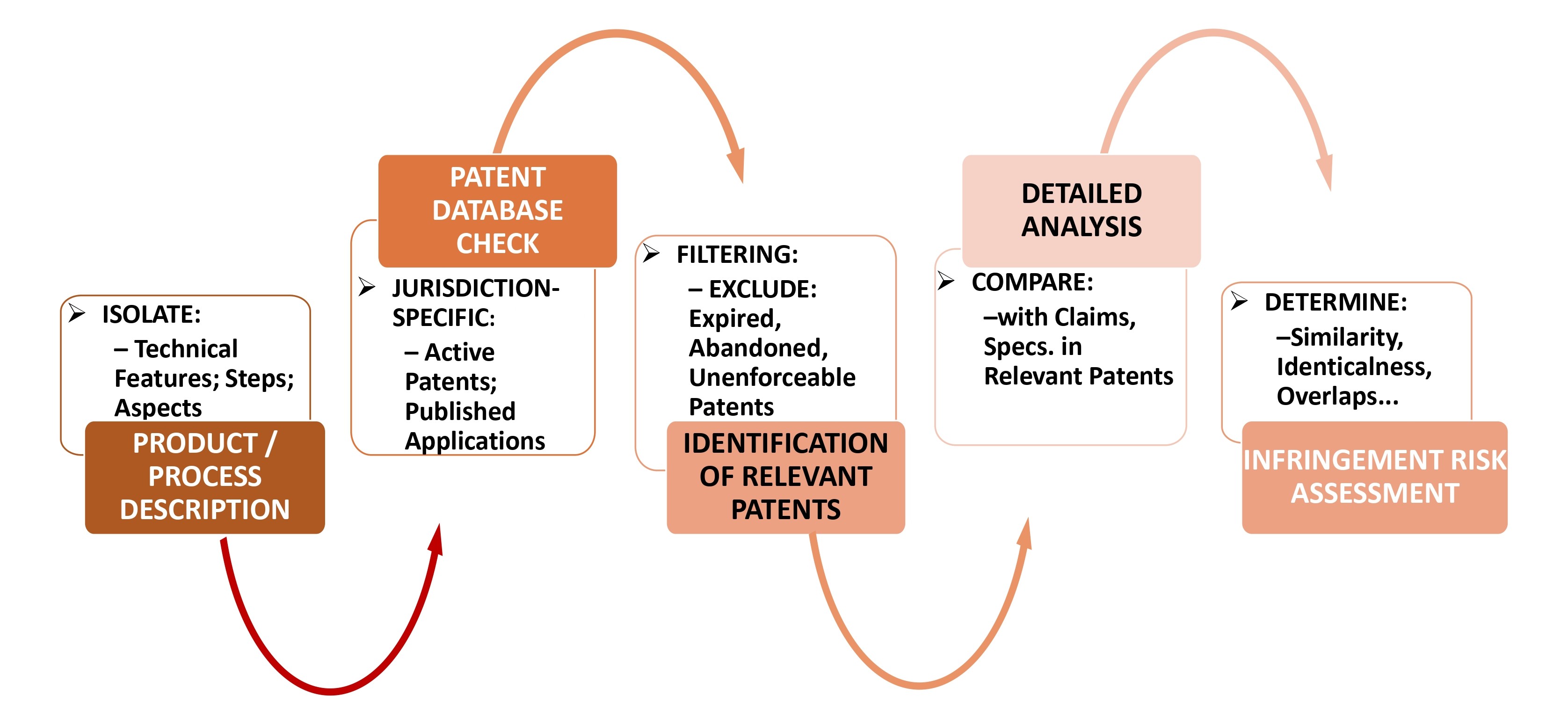
To begin with, the IP analyst isolates all the technical features, components, and processes that makeup the invention.
After the previous product breakdown step, the analyst conducts an exhaustive search of patent databases, such as Google Patents or the WIPO PATENTSCOPE, in the jurisdictions where the product will be used, sold, manufactured, or imported. This search primarily focuses on active (enforceable) patents and pending (published) applications, potentially covering aspects of the product or process in question.
Expired, abandoned and non-enforceable patents in the target market are filtered out. Once relevant patents are identified, a detailed analysis is carried out to compare the patent claims with the features of the product or process to assess the likelihood of infringement. If multiple technologies are involved, the analysis addresses each relevant technology area.
FTO opinions are not guarantees against future infringement litigation. Patent landscapes evolve continuously and incrementally as new patents are granted and applications published. While not currently enforceable, pending applications may mature into patent grants and pose infringement risks in the future.
Since patent rights are territorial, FTO searches are performed for particular regions or countries where launch of the product is planned. Searching patent repositories of only the home country leads to geographic misalignment; it produces sub-optimal results, specifically when the plan is to sell globally.
FTO analysis must be not equated with patentability check. While a patentability assessment evaluates whether an invention is novel, useful, and inventive enough to obtain a patent, a FTO analysis solely focuses on testing if the given product overlaps with someone else’s legal monopolies; and, potentially infringes existing patents and patent applications.
Consequently, FTO assessments should be periodically updated, especially when products are modified or commercialized in new jurisdictions.
FTO analyses are a critical risk-management tool that helps organizations identify patent-related obstacles before commercial launches of products in new markets; assess legal risks; and, formulate appropriate business strategies.
If the FTO review reveals potentially blocking patents, several options may be considered, including redesigning the product to avoid infringement, obtaining a license from the patent owner, challenging the patent validity, acquiring the relevant IP rights, or delaying market entry until the patent expires.
It is obvious that FTO assessments are particularly relevant when significant investments are planned for scientific research, product design & development, manufacturing facilities, regulatory approvals, market launches, or M&As (mergers and acquisitions). Potential investors and business partners often insist on a FTO clearance before committing resources to a project.
Thus, FTO analysis offers insights into the intellectual property (IP) landscape; it facilitates informed decision-making, protects investments, and enables the successful introduction of innovative products into the marketplace. It mitigates the likelihood of costly product recalls, infringement litigation, disruptions to commercial operations, damages claims and injunctions.
At BLAZE VENTURES, we have elaborate processes and qualified professionals for performing freedom-to-operate analysis and providing inventors and enterprises with strategic advice on IP-related impediments to product launches in new markets.