The Doctrine of Equivalents is a legal principle that that enables a patentee to assert rights and claim infringement despite the competing product or process not falling within the literal wording of the patent's claims.
On the flip side, this patent law tenet prevents an infringer from escaping liability with the introduction of only minor, trivial, or insubstantial changes to a patented invention while retaining its core functionality and all its essential features.
The doctrine seeks to strike a balance between two competing objectives: (i) protecting patents from unfair imitation; and, (ii) affording clear notice of the scope of patent claims to the general public so as to prevent patentees from ‘overreaching’.
A product or process generally infringes a patented invention, only if it contains every element of at least one patented claim exactly as claimed―this is known as literal infringement. However, competitors may adopt the ploy of making minor modifications, which fall outside the literal construction of the drafted claims, to evade infringement.
The Doctrine of Equivalents addresses such scenarios, wherein the infringing products or processes are substantially the same as the patented inventions, by extending protection of rights beyond the precise language and literal sense of claims in the patent.
For instance, if a patent claim specifically references a metal leaf spring as a fastening mechanism, a competitor may substitute a flexible rubber component that delivers the same functionality, performs in almost the same manner, and produces the same result. A court may hold that there has been infringement under this doctrine despite a metal spring being absent in the infringing product.
To prove infringement under the Doctrine of Equivalents, courts in many jurisdictions apply the function-way-result test. This test examines whether the infringing part/step, vis-à-vis the claimed part/step in the patented invention: (a) performs substantially the same function; (b) in substantively the same way by using same/similar mechanics, chemistry, processes, etc.; and, (c) achieves essentially the identical result.
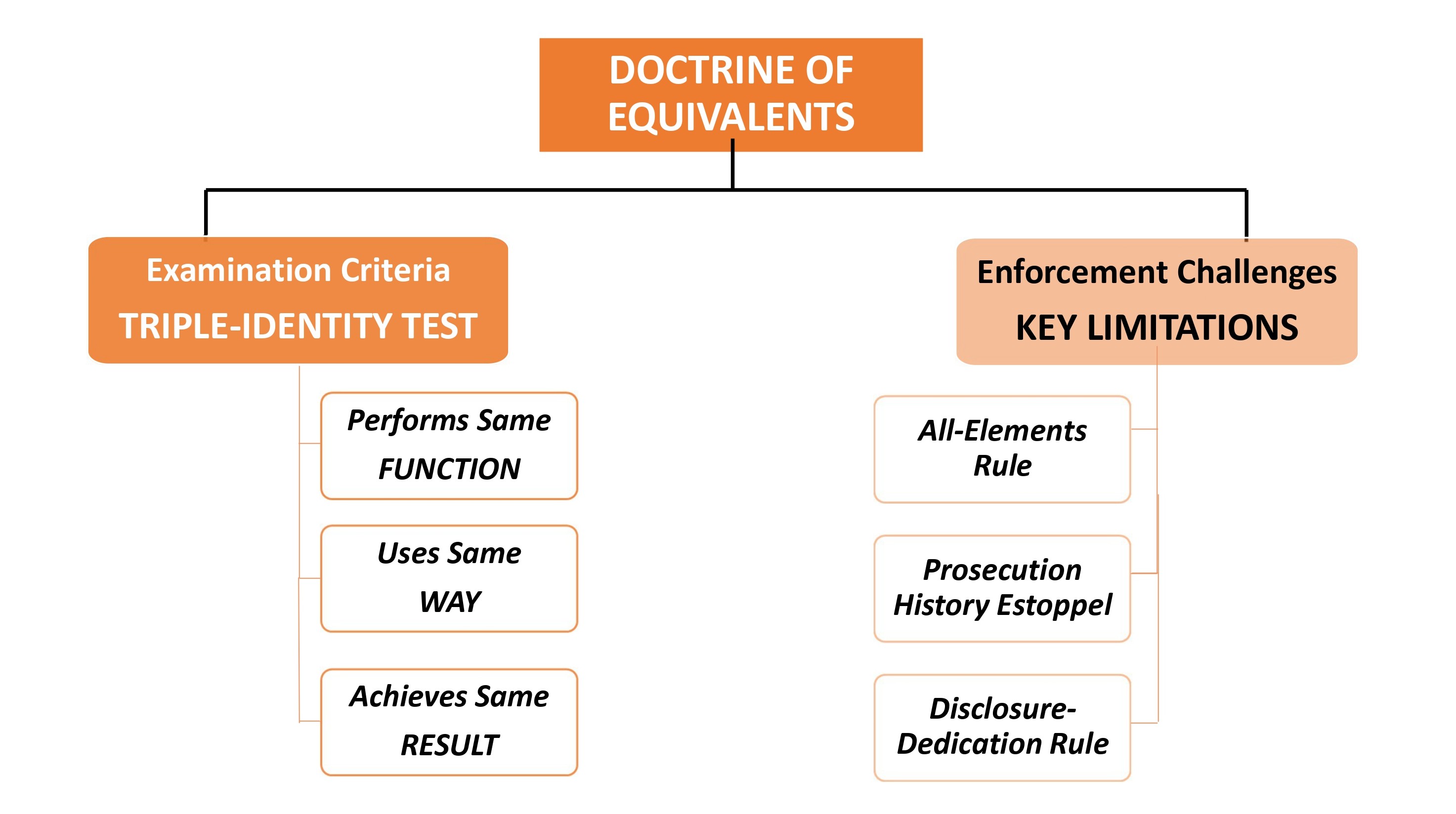
If all three criteria are met, the element, that is, part or step in the infringing, modified product may be deemed an equivalent of the patented invention. This doctrine is extremely significant in the United States, where it was well-settled by the landmark judgment in Graver Tank &Manufacturing Co. v. Linde Air Products Co.[1]
During enforcement courts subject this doctrine to key limitations, which encompass:
This doctrine is a highly mature principle and is relied upon through rigorous judicial tests in the US and Europe. However, in general courts desist from applying the doctrine if doing so would effectively eliminate or ignore a specific claim limitation.
In other geographies, such as India, courts have struggled with the consistent application of the doctrine, and infringement litigation often defaults strictly to literal interpretations and constructions. But evolving jurisprudence increasingly looks to the "essence" of the invention to prevent minor or trivial circumventions.
In summary, the doctrine serves as a safeguard against attempts to bypass patent rights through trivial modifications. It ensures that patent rights are confined to not only the exact wording of drafted claims, but also equivalent variants embodying the same inventive concept. Thus, it achieves a balance between fair protection for the patentee and a reasonable degree of legal certainty for third parties.
At BLAZE VENTURES, we have elaborate processes and qualified professionals for strategically advising inventors and enterprises on the effective creation and protection of IP rights for their ideas, innovations and inventions.
______
[1] 339 US605 (1950)