In patent law, “added subject matter” is a crucial concept, which pertains to additional technical features, functions or specifications that may be introduced into a patent application after its original filing (priority) date. It governs the extent to which a patent application may be amended after its initial filing.
Follow-on inventions are a closely related concept. They are improvements, modifications, or developments arising from an earlier invention. Together, these principles balance the interests of inventors, competitors, and the public by preserving legal certainty while encouraging innovation.
To ensure applicants do not gain an unfair advantage, patent offices in most jurisdictions prohibit amendments that introduce new technical information beyond the content of the original application filed. This is meant to prevent inventors from expanding their original invention to cover concepts, technologies or functionalities that were undisclosed earlier.
Thus, if an amendment attempts to add, alter or remove claims, features, description, drawings, embodiments, or technical details that a skilled person cannot directly and definitively derive from the original disclosure, then the application for such amendment is likely to be rejected or the resulting patent later invalidated or revoked during the course of post-grant prosecution proceedings.
Added subject matter is prohibited because of multiple reasons.
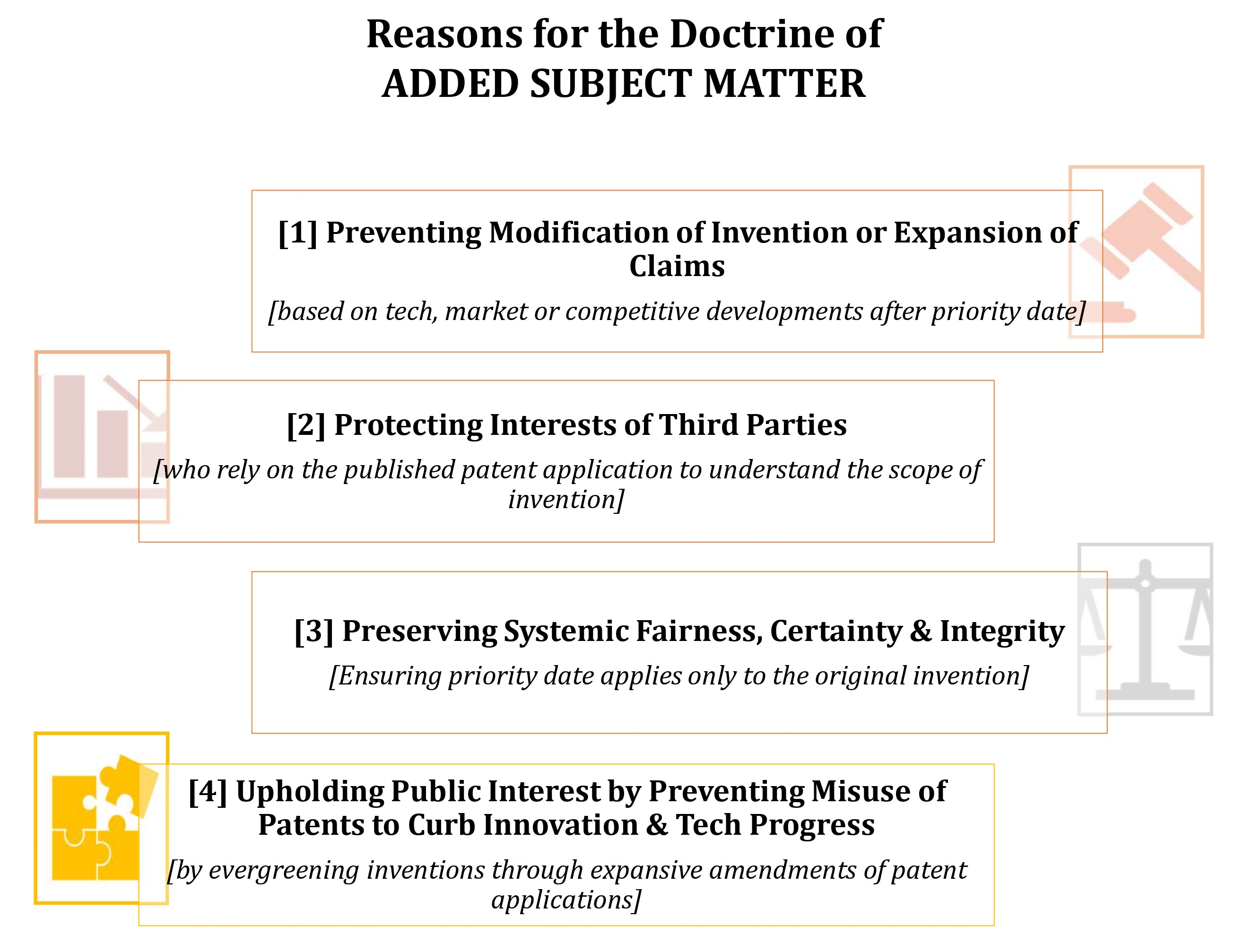
To begin with, it protects third parties who rely on disclosures in the published patent application to understand the scope of the inventor’s contribution. Then, it prevents applicants from modifying their inventions or broadening claims therein after gaining knowledge of competitors’ developments.
Finally, the doctrine of added subject matter preserves fairness, certainty, and integrity in the patenting system by ensuring that the priority date applies only for the invention that was truly and actually disclosed in the filed application. The principle ensures the system is not misused to curb innovation and strangle technological progress.
Amendments that are likely to be disallowed include:
Examples of added subject matter include improved manufacturing methods, enhanced product features, new formulations, or alternative technical solutions. Such additional innovations also perhaps can be patented, provided they satisfy the patentability criteria of novelty, inventive step, and industrial applicability.
It is vital to be aware of the distinction between permissible amendments and impermissible added subject matter; this is normally a significant issue during pre-grant and post-grant patent prosecution.
Patent application drafters must therefore be diligent enough to incorporate comprehensive descriptions, detailed drawings, alternative embodiments, and fallback positions in the original specification. A well-drafted application provides flexibility for future claim amendments, while staying within the boundaries of the original disclosure.
Instead of attempting to amend the original application, it is preferable to protect such add-on or follow-on inventions through separate patent applications, divisional applications, continuation applications, or patents of addition, depending on the jurisdiction. Such follow-on inventions provide a mechanism for protecting subsequent technological advances.
At BLAZE VENTURES, we have elaborate processes and qualified professionals for strategically advising inventors and enterprises on the effective creation and protection of IP rights for their ideas, innovations and inventions.