Patents confer a temporary monopoly on inventors to exploit commercially and monetise their inventions; this exclusivity is not absolute. In some jurisdictions, a government body or other competent authority is statutorily empowered to permit a third party to produce, use, or sell a patented invention under a compulsory licensing agreement, without the consent of the patent owner.
Compulsory licensing is a vital mechanism within patent law balances exclusive rights granted to patent holders with broader public interest. It functions as a crucial tool for affordable access to patented medicines and technologies.
The primary objective of compulsory licensing is to prevent abuse of exclusivity rights over patents for adopting monopolistic practices; market skimming prices; and, profiteering policies. The principle is to ensure that patented inventions serve larger public good and societal needs, particularly in situations of national crises and public health emergencies.
This mechanism ensures that the patents are not used as exploitative tools for unjustified price control, artificial scarcity creation, or denial of access to essential technologies. It ensures access to essential goods (like pharmaceuticals) while still affording a reasonable return for the patentee.
Article 31 of TRIPS (Agreement on Trade-Related Aspects of Intellectual Property Rights) permits member states to compel compulsory licensing of inventions under specific conditions, including prior efforts to obtain a voluntary license on reasonable terms.
The Doha Declaration on TRIPS and Public Health (2001)further clarified that member states have the right to grant compulsory licenses and the freedom to determine the grounds upon which such licences are granted. It was affirmed that the TRIPS should be interpreted and implemented in a manner supportive of WTO members' right to protect public health and promote access to medicines for all.
Thus, subject to the provisions in local patent law, a government body or other competent authority can grant compulsory licenses to another entity, such as, for example, a generic drug maker, to manufacture the product, with mandatory royalty payments to the patent owner.
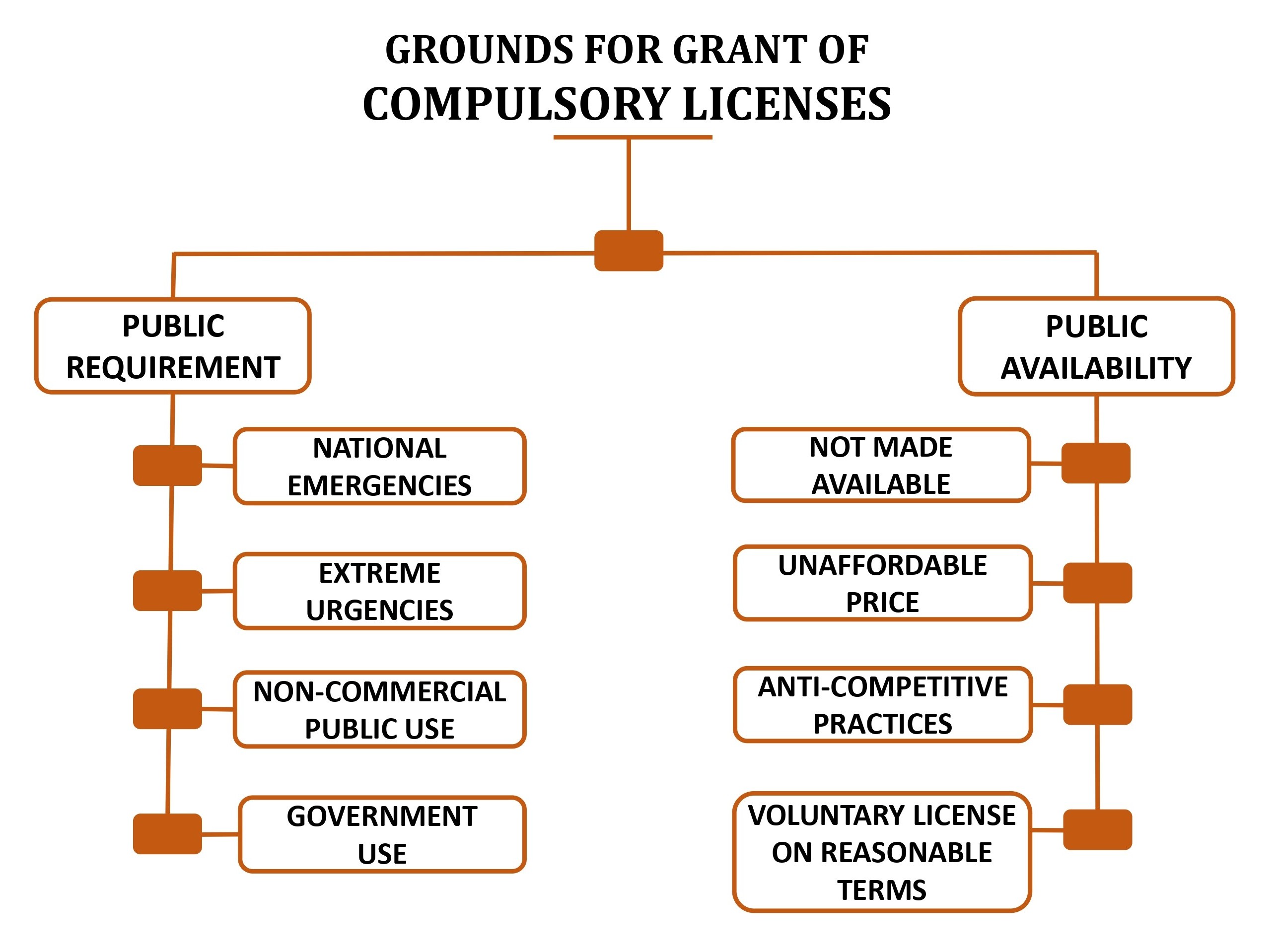
In consonance with the TRIPS framework, many countries have made detailed provisions for compulsory licensing in their respective patent enactments. Many enactments provide for the issue of compulsory licenses either for extreme urgencies, national emergencies, and non-commercial public use; or, if the patented invention is not made available in the country or has an unaffordable price.
For instance, Indian laws allow any interested person to apply for a compulsory license after three years from the grant of a patent on grounds that the patented invention: (i) has not satisfied reasonable public requirements; (ii) is not available at a reasonably affordable price; or, (iii) is not worked in the territory of India.
The Indian framework emphasizes affordability and local working, reflecting the country’s socio-economic priorities. The landmark Indian case of Bayer Corporation v. Natco Pharma Ltd. (2012), wherein the Controller of Patents granted a compulsory license for Bayer’s patented cancer drug, Nexavar, citing its exorbitant price and limited availability. The decision significantly reduced the cost of the drug and reaffirmed the role of compulsory licensing as a public welfare tool.
Compulsory licensing is often criticized for potentially impeding innovation and discouraging investment. Yet, it remains a lawful and necessary safeguard. When used judiciously, it ensures that the patent system fulfils its fundamental purpose...that of promoting innovation while serving public good.
At Blaze Ventures, we have elaborate processes and qualified professionals to strategically advise parties on seeking the grant of compulsory licenses for patented inventions.