Patent pooling is a collaborative arrangement, in which multiple patent owners combine related intellectual property assets into a single portfolio. Such a combined package is then licensed either to each other or to third parties. This helps licensee-companies to: (a) avoid separate negotiations with multiple licensors; and, (b) gain access to multiple essential technologies with a single licensing agreement.
Such pools are most common in industries, where products integrate several complex, interrelated technologies, such as, biotechnology, consumer electronics, medical equipment, telecommunications, etc.
Creating complex products—such as, smartphones, MRI scanners, 5G networks, etc.—requires several overlapping patents. Such “patent thickets”―the term refers to a dense web of overlapping and inter-linked intellectual property rights that must be navigated to commercialize a product―pose a challenge for product development.
Thus, when a product requires dozens or even hundreds of patents, negotiating individual licenses can be expensive, time-consuming, and uncertain. Therefore, the primary purpose of a patent pool is to reduce transaction costs and simplify licensing processes.
A patent pool also allows prospective licensees to obtain the necessary rights comprehensively through a single license, thereby eliminating "royalty stacking," which is the cumulative effect of paying high fees to multiple patent holders. Such pooling broadens access to cutting-edge, emerging technologies for smaller firms.
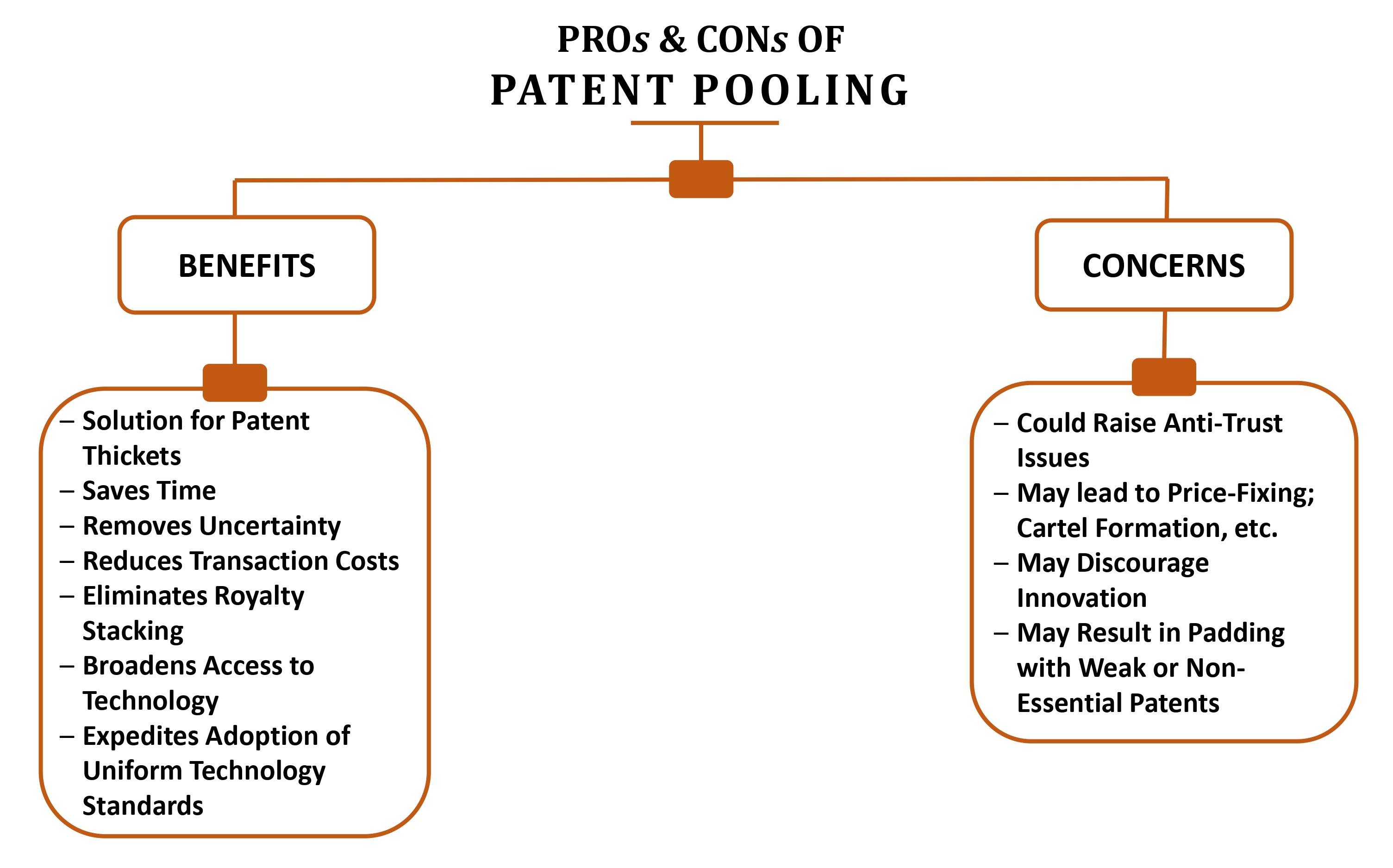
Cross-licensing within the patent pool can also reduce disputes among members. Pools can also accelerate adoption of uniform technology standards (such as, video codecs, Wi-Fi, Bluetooth, etc.) used frequently to enable communications and interoperability among devices manufactured by different companies.
Despite the aforesaid advantages, patent pools raise competition law (anti-trust) concerns. Dominant enterprises may use pooling to exclude competitors, fix prices, form cartels, or otherwise dampen innovation. Such anti-competitive strategies are closely monitored by industry regulators, who may be forced to intervene.
Furthermore, regulators also make sure pools are not padded with weak or non-essential patents to drive up licensing fees. Therefore, many jurisdictions mandate that pooled patents be essential to a particular standard or technology and that licensing terms be fair, reasonable, and non-discriminatory (FRAND).
In conclusion, patent pooling is a crucial strategy for addressing complex patent landscapes. When judiciously structured, it can reduce legal uncertainty, facilitate the widespread adoption of standards; and, encourage innovation, without sacrificing the interests of IP owners and technology users.
At BLAZE VENTURES, we have elaborate processes and qualified professionals for advising inventors and enterprises strategically on the effective creation, protection and commercial exploitation of IP rights over their ideas, innovations and inventions in multiple jurisdictions.