Like novelty, obviousness is judged by the state of art, excluding the material published in breach of confidence and at international exhibitions. Non-obviousness, or inventiveness, is ascertained by viewing the whole invention against all publicly disclosed ideas and inventions in the field. The ’obviousness’ has to be strictly and objectively determined.
In essence, inventiveness in patent law ensures that patents are granted for truly novel and non-obvious advances, rather than for minor or predictable modifications of existing technology. Thus, by mandating a non-obvious contribution to the state of the art, patents reward genuine innovation, stimulate further research, and benefit society ultimately through the dissemination of new and useful technologies.
Assessment of inventiveness is based on four aspects, namely: (i) The scope and content of all public disclosure (i.e., prior art) in the field; (b) The differences between the claimed invention and the prior art; (c) The level of required skill in the relevant field for validating inventiveness; and, (d) Objective evidence of inventiveness, such as commercial success or unexpected results.
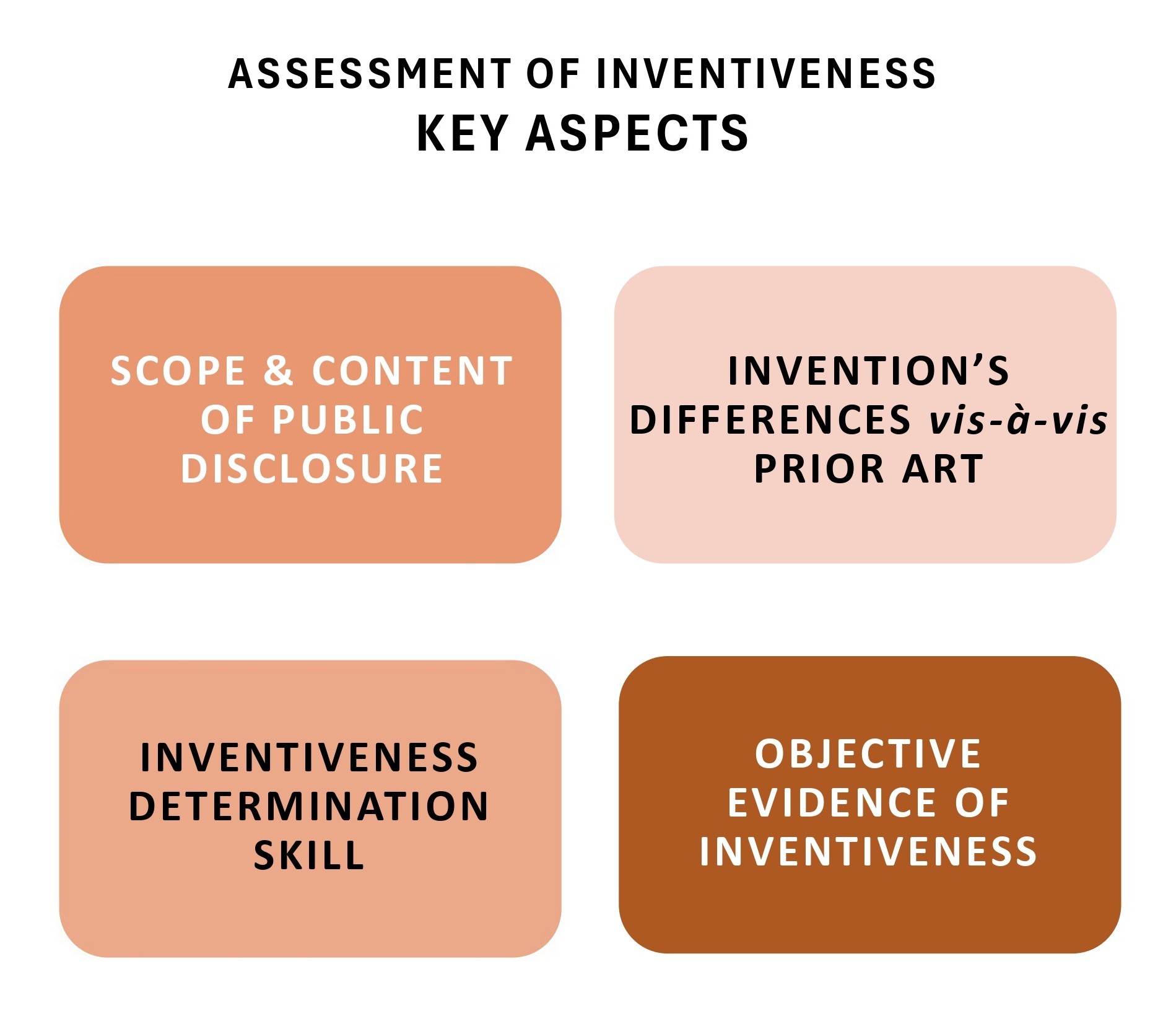
Thus, the comparison is between: (i) the state of art; and, (ii) the invention claimed by the patent applicant. The inventive step, i.e., inventiveness may lie in seeing that a particular solution to a problem should be adopted; it does not have to be found in the technical means that are then employed.
Hindsight bias is avoided in the assessment by basing it on what would have been obvious at the time of the invention, not with the benefit of knowledge thereon. Also, patentability is not negated by the manner in which the invention was conceived or accomplished.
The existence of an inventive step is gauged from the perspective of a person with ‘skill in the art (SITA)’, a hypothetical individual or notional worker with skills and knowledge in the field of invention in question.
Thus, inventiveness must be demonstrated in the patent application. This necessitates detailed comparisons with existing technologies, known as prior art. Patent examiners assess inventiveness by conducting prior art search and evaluating the differences between the claimed invention and existing disclosures.
Hence, inventors and patent attorneys must file patent applications, which identify the problems solved by the inventions; elaborate short-comings of prior solutions; and, highlight the benefits and advantages achieved thereby. It must be clearly explained why the claimed invention is not an obvious next step, but rather a creative leap forward.
At BLAZE VENTURES, we have elaborate processes and qualified professionals for assisting innovators and enterprises to assess and ascertain inventiveness of their ideas, innovations and inventions.