It is possible to realise the economic value of patented inventions through various means—royalty payments area preferred mechanism for monetising patents. Patent royalties are contractually-binding payments made to a patent owner (licensor) by a licensee for the right to use, manufacture, or sell the patented invention.
Royalties are the consideration paid to a patentholder by a licensee in lieu of the right to use, manufacture, sell, or otherwise exploit a patented invention. In essence, patent royalties are the link between innovation with commercialization; they enable inventors to monetise patent assets while allowing others to gain access to and exploit the intellectual property rights therein.
A patent confers a time-limited monopoly, typically 20 years, during which the patentee can prevent unauthorised use, sale or production of the patented invention. Instead of exercising outright this exclusivity, patent holders often choose to license their rights. Royalties then function as the price for permitting lawful use of the IP rights over the patented invention.
Thus, royalties are conceptually founded on the exclusive IP rights granted under law to patented inventions. It is obvious that license fees and royalties promote wider dissemination of technology while rewarding inventive effort, and not stifling it.
Royalty payments can be structured in various forms. These payments are structured as percentages, fixed fees, or lump sums to compensate for intellectual property usage.
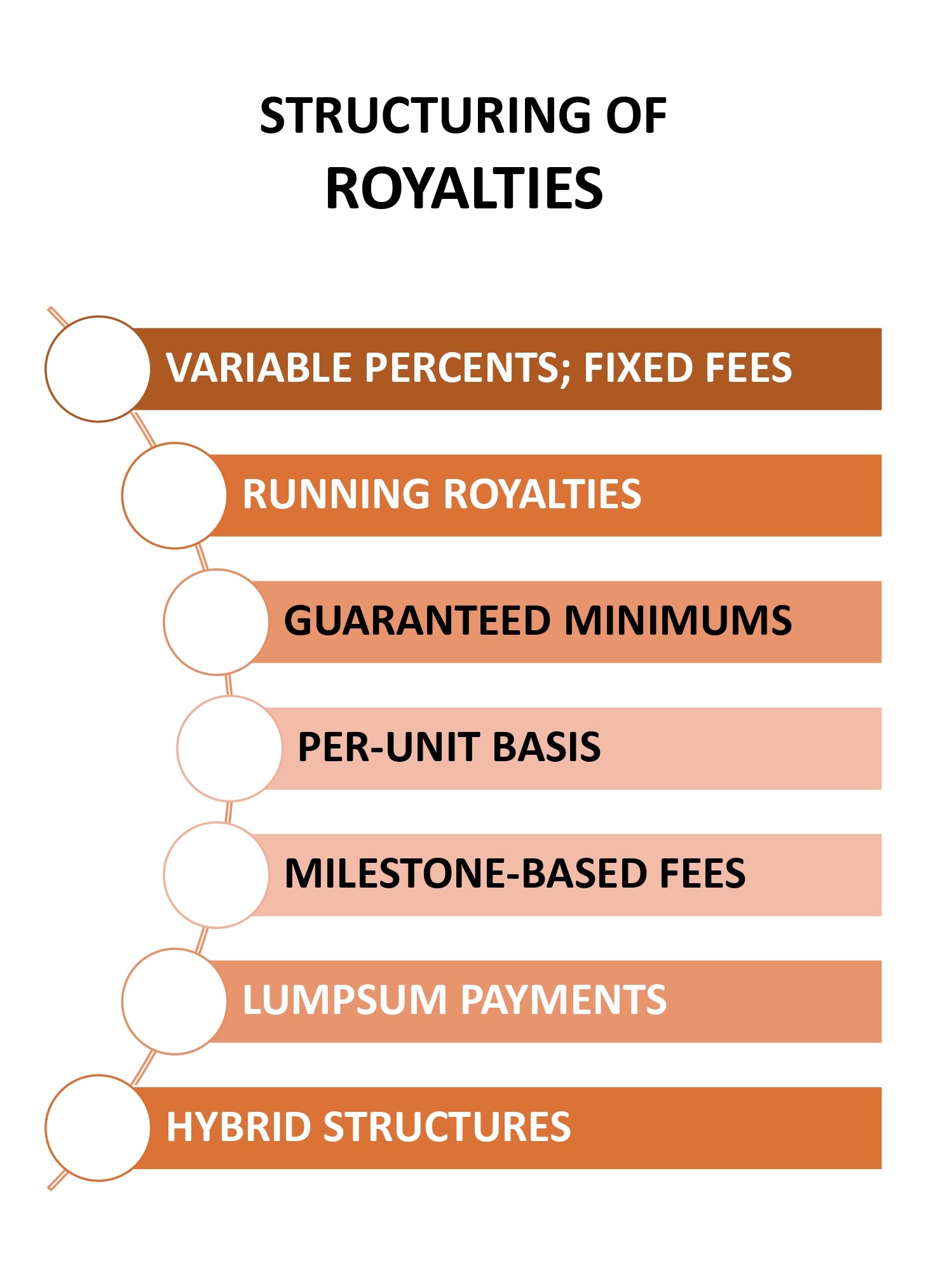
The most common is a running royalty, generally calculated as a percent of net sales or gross revenues generated from the patented invention. The periodicity of the payment could vary. It is oft supplemented with a guaranteed minimum royalty payment to the licensor, regardless of sales or revenue.
Royalties may be alternatively fixed on a per-unit basis, offering predictability for both parties. Parties may also agree to a lump-sum amount or milestone-based fee for the license, which covers the entire term. Hybrid structures combining upfront initial fee payments with ongoing royalties are also widely used.
Determination of the appropriate royalty rate is a complex exercise influenced by legal, economic, competitive and technical considerations. Factors typically include the scope, strength and competitive value of the patent; its remaining term; criticality of the patent to business success and its market impact; product uniqueness; market size and prevalent industry practices. Eventually, negotiation between the parties too plays its part.
Often Comparable Uncontrolled Price (CUP) method is used to determine rates based on similar licensing agreements in the market. The actual royalty rates though vary by industry vertical and market niches.
In litigation and compulsory licensing contexts, courts and regulators often apply concepts such as “reasonable royalty” and “fair, reasonable and non-discriminatory (FRAND)” terms to prevent abuse of patent rights while ensuring adequate compensation to patentees.
The basis for determining the royalty rate is an integral aspect of license negotiations. The computation method to be used therefor—for instance, should it be a percentage of net sales or gross revenues; EBITDA or net earnings, and so on— is also critical.
The specifics of guaranteed fee payouts, payment frequency (e.g., monthly, quarterly or annual)and, if applicable, step-down rates on patent expiry or revocation to avoid legal risks, are also issues for negotiations. Audit and verification mechanisms may also be factored into contracts.
Royalty arrangements can frequently lead to disputes, specifically over royalty stacking, valuation of standard-essential patents, allegations of excessive product pricing, discounting policies, etc. Balancing the patent owner’s right to reward with public interest in technology access and competition is an ongoing challenge.
On the whole, patent royalty payments are a vital instrument for translating exclusive legal rights into economic value; royalties not only sustain innovation, but also enable technological diffusion and knowledge dissemination. Royalties provide a revenue stream that can be reinvested into further R&D.
For startups and small entities, royalty incomes can eliminate the need for investments on manufacturing facilities, market entry and business development; and, also the risks associated with commercialisation. From a policy perspective, a well-oiled royalty system incentivises invention patenting, while also facilitating technology transfers.
At BLAZEVENTURES, we have elaborate processes and qualified professionals to advise parties on the drafting of licensing agreements and structuring of royalty payments for patented inventions.