Patentability refers to the legal criteria that an invention must satisfy to be eligible for patent protection. These criteria are designed to ensure that patents are granted only to innovations that are genuinely novel, useful, and non-trivial. The underlying objective is to strike a balance between fostering or incentivizing innovation with the broader public interest, specifically in a developing nation with diverse economic and social needs.
The core requirements for patentability include primarily, novelty, non-obviousness ( or, inventive step), and utility (or, industrial applicability). Thus, a patentable invention is a new product or process involving an inventive step and having utility, that is, capable of industrial application.
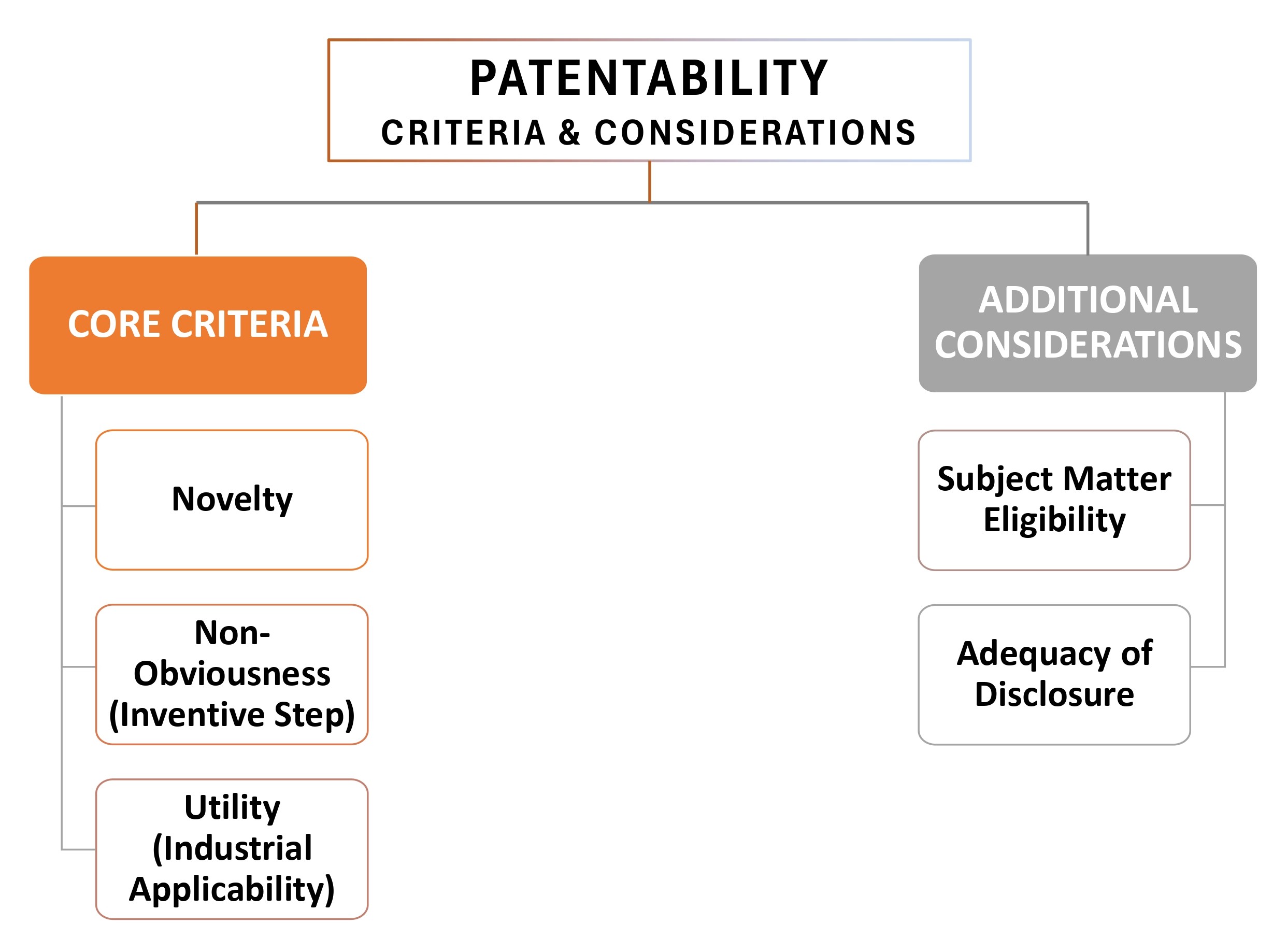
Additional conditions, like subject matter eligibility and adequate disclosure, are also applicable. These criteria are aimed at preventing the re-grant of patents for existing products, processes or technologies and ensuring that only truly new inventions are protected.
Novelty demands that the invention not be part of prior art, that is, there must not have been public disclosure in anywhere before the date of filing the patent application therefor. This means any public use, publication, or sale before filing can render an invention non-patentable.
Most major jurisdictions, like the US, India, Japan, etc., adhere strictly to the "absolute novelty" standard, which requires an invention to be completely new and not disclosed to the public in any form anywhere in the world prior to the filing date. Other jurisdictions may provide for a grace period, allowing some limited disclosures by the inventor (say, for experimentation) to occur within a specific timeframe before the patent application.
Non-obviousness, or inventive step, requires that the invention not be an obvious or commonsensical modification of existing knowledge to someone skilled in the relevant field. For instance, minor changes like altering the color or size of a product typically do not qualify unless they bring distinct technical benefits. This involves a technical advance over existing knowledge or economic significance that is not obvious.
Utility (or, industrial applicability) mandates that the invention can be made or used in an industry. Thus, industrial applicability is broadly interpreted to include any productive activity, from agriculture, manufacturing and services. In other words, it implies the invention must be practically useful (not theoretical or speculative) and permit production or application in an industry.
Patentable subject matter is another critical criterion. Certain ideas—such as, laws of nature, abstract concepts, natural phenomena, mathematical formulas, etc.—are excluded from patent protection in most jurisdictions. Additionally, some countries exclude business methods, methods of medical treatment, and software, though this varies.
Adequate disclosure refers to the inventor(s) describing the invention in detail and clearly explaining the functioning thereof, which enables others skilled in the field to verify, validate or reproduce it. This ensures that in exchange for exclusive patent rights, the public gains access to the technical knowledge.
Ultimately, patent regimes seek to encourage genuine innovation while serving broader socio, economic and technological goals. Inventors must navigate effectively the legal, technical, ethical and business challenges and considerations for securing patent protection and for ensuring their inventions contribute meaningfully to both industry and society.
At BLAZE VENTURES, we have elaborate processes and qualified professionals for helping innovators and enterprises ensure patentability of their ideas, innovations and inventions.