Based on the nature of invention and protection purpose, patents may be broadly categorised into utility, design and plant patents. Further, patent applications vary too on the basis of filing stage, route, and situation.
Inventors have the option of making an initial, less formal application, called the ‘Provisional Application’ to secure an early date and "Patent Pending" status for 12 months, allowing time to develop the invention before filing a ‘Full-Specification”, or, ‘Non-Provisional’ application.
Strictly speaking, the ‘provisional application’ is not a patent type in substance; it is a temporary filing option available in several jurisdictions like the US, Australia and India. In some jurisdictions, like Canada, such preliminary applications are termed ‘Incomplete Application’.
This advance filing not only secures an early priority date without formal claims, but also begets more time for the inventors to file a full-specs application. In the event, the non-provisional application is not filed within the 12-month period, the provisional application expires.
Alternatively, inventors may also opt to directly file―that is, by bypassing the ‘provisional application’ stage―a fully-disclosed, ‘full-specification’ application, which must comprise of the detailed specifications and claims of the invention. However, in the event a ‘provisional application’ is filed first, then the ‘full-specifications’ application for the invention must be filed within 12 months of the priority date, that is the date of filing of such provisional application.
Inventors may either choose the “Ordinary” route of filing directly separate patent applications with the patent office in each specific country where protection is sought. This approach is ideal either when there is great clarity on the countries to seek patent protection in or when obtaining faster grants in specific countries is a key objective.
In some regions, applications can be filed with patent offices that have jurisdictions across multiple member-states. The European Patent Office (EPO); Eurasian Patent Organization (EAPO); Organisation Africaine de la Propriété Intellectuelle (OAPI); African Regional Intellectual Property Organization (ARIPO); etc., are some of the primary offices, which grant patents that are valid in multiple countries.
The ’ordinary’ method allows for the tailoring of applications for each jurisdiction's rules; it also may potentially save time and money by circumventing the longer Patent Cooperation Treaty (PCT) processes. The actual filing may be done simultaneously in multiple countries; or at different times, conforming with to each country's specific laws, regulations and deadlines.
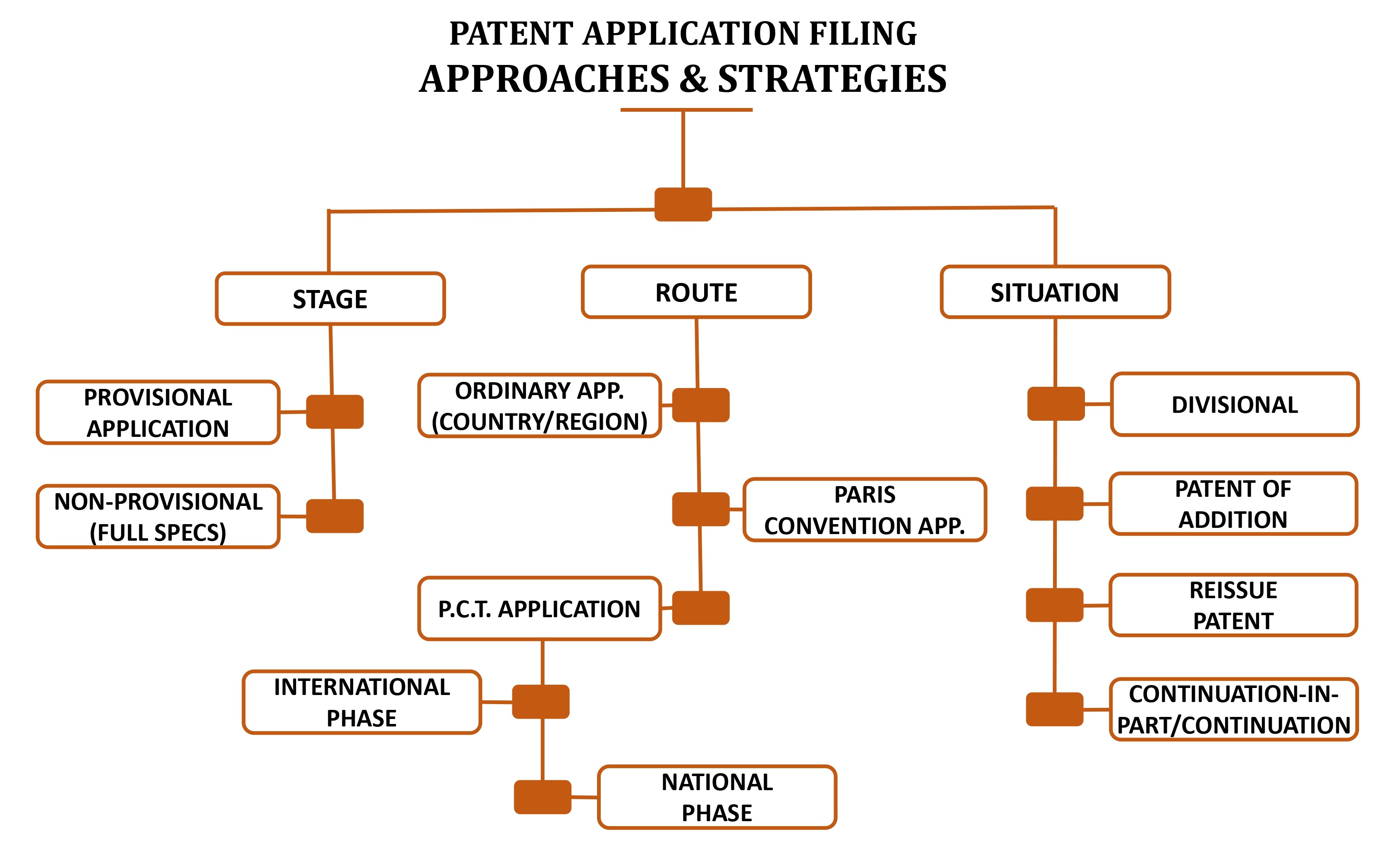
Under the Paris Convention, an ‘ordinary application’ can even be filed in one country first; and, thereafter applications may be filed in other countries claiming the original filing date as the priority date.
Optionally, in contrast to independent filings, applications can be filed in multiple geographies (that is, countries and regions) via the Patent Cooperation Treaty (PCT). This provides an international mechanism for securing patents in multiple countries via a single filing in the ‘International Phase’, which is later followed by filing of applications in over 100 specific countries in the ‘National Phase’.
In most jurisdictions, the patent law provides for filing of ‘Divisional Applications’, which are patent applications separately carved out from a parent application that is comprised of several distinct inventions. Each divisional application is then examined individually, while retaining the parent application’s original date of priority. While such applications must be consistent with the original disclosure, it must not introduce any new aspects, which materially alter the original invention.
In some countries, such as, India, Australia, etc., ‘Patents of Addition’ are granted to inventors for minor modifications or enhancements to an existing patent. It essentially is an incremental extension of and expires along with the main patent. It is economical since it does not require the filing of new application or the payment of separate fees.
Some patent offices, such as the USPTO, provide for “Reissue Patents”, which are corrected versions of existing patent and are issued to fix significant errors (like overly broad or narrow claims, or mistakes in description/drawings). Filing of reissue patent applications is made to correct unintentional and inadvertent mistakes that made the original patent partly or wholly invalid.
A “Continuation Patent” is a new application filed to pursue different claims or to refine protection pursuant to an earlier application prior to the patent for the original invention being granted or abandoned. A “Continuation-in-Part (CIP)” application seeks to incorporate additional disclosures and claims in the original application; therefore, a CIP is partly novel and partly a continuation.
At Blaze Ventures, we have elaborate processes and qualified professionals for strategically advising inventors and enterprises on the effective protection of IP rights over their ideas, inventions and innovations in various countries, regions and geographies.