To ascertain the novelty of an invention, all publicly disclosed inventions must be diligently reviewed. This entails the examination of patent and non-patent documents, records, databases, literature and other disclosures in the public domain in order to ensure that there are no prior publications or activities that may have disclosed similar inventions.
If the invention is found to be similar to an existing piece of prior art, it is considered to lack novelty and hence deemed to be not patentable. Any patent application for such a non-patentable invention is certainly liable for rejection. However, if the review does not reveal any prior art that discloses the same or similar invention, the instant invention is deemed to satisfy the novelty criterion, which is a pre-requisite for patentability.
Prior art reviews generally entail a search of various online and offline information, content, catalogues, repositories and other sources of public disclosure to establish the non-existence of similar or identical invention.
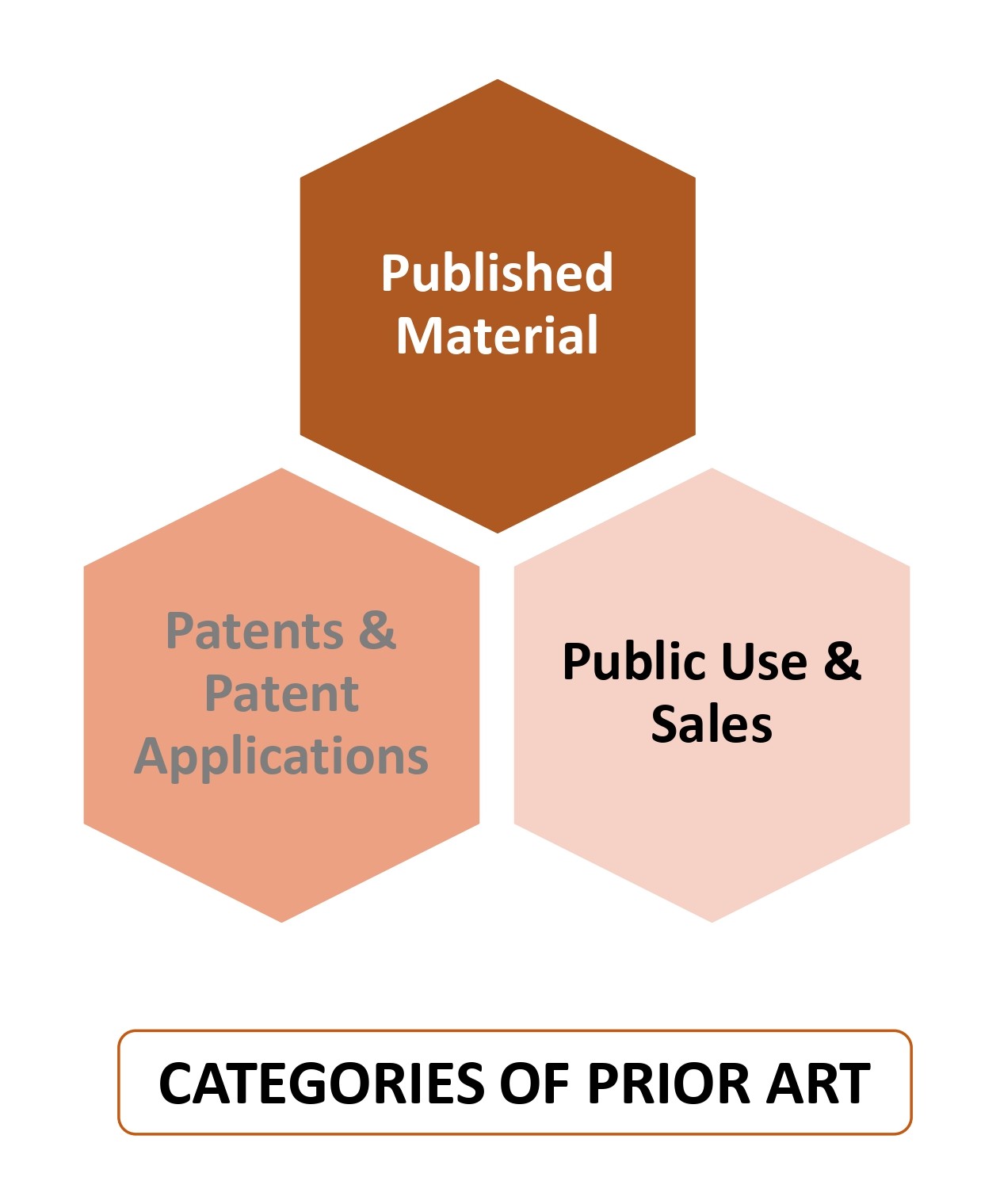
Searches of granted patents and filed patent applications may extend to numerous free, public repositories, both governmental and open-source, which give: (i) global coverage, such as, WIPO Patentscope; Google Patents; Espacenet; and, (ii) regional coverage, such as, USPTO Patent Public Search (US), EPO European Patent Register; DPMAregister; InPASS (India); CIPO (Canada); CNIPA Database (China); JPO (Japan), etc.
Paid commercial databases, with advanced search, data manipulation, analytics and other functional enhancements, such as: PatBase, Derwent World Patents Index, CAS STNext®, PatSnap, DWPI (Derwent World Patents Index), Orbit Intelligence, Questel Orbit, PatentSight, etc., may also be explored.
Academic papers, journals, doctoral theses, books, grant proposals, seminar presentations, besides other kinds of published and unpublished documents, may be researched. Posters, abstracts, e-mail correspondence, minutes of meetings, records of other proceedings, etc. also maybe deemed to be public disclosure, particularly if confidentiality and non-disclosure restrictions are not applicable to such material.
Scholarly articles and research papers on public platforms and repositories that: (a) provide free access, such as, Google Scholar, CORE, Academia.edu, Directory of Open Access Journals (DOAJ); and, (b) offer subscription-based access, such as, JSTOR, IEEEXplore, IP.com Prior Art Database (PAD), Scopus and Web of Science, PubMed and ResearchGate, are relied upon for this research.

Online resources (such as, websites, online databases, blogs, social media, etc.); and, other published material (such as, product catalogues, marketing collateral, advertisements, etc.) may also be explored to search for the existence of same or similar invention in prior art.
If any invention is used publicly or sold prior to the filing of a patent application therefor, then such invention is deemed to have been publicly disclosed; such inventions will fail the novelty test. It is public disclosure if a slide-deck or handout is distributed during a formal (or informal) conference talk or oral presentation, in which details of an invention are shared. It may also be disclosure, if an audience member takes notes of an invention during such interactions. Hence, inventors have to exercise discretion to avoid such inadvertent disclosure.
At Blaze Ventures, we have qualified professionals and elaborate processes for conducting comprehensive review of prior art in order to establish novelty and to validate patentability of ideas, innovations and inventions.