FRAND is an abbreviation that stands for “Fair, Reasonable, and Non-Discriminatory”. It stands for the principles governing the licensing of Standard Essential Patents (SEPs).
These terms obligate owners of Standard Essential Patents (SEPs)—patented inventions and technologies necessary to comply with a technology standard (such as 5G, Wi-Fi, etc.)—to license their patents to others on terms that are equitable, non-discriminatory, and consistent.
IP Protection with SEPs
SEPs are patents that protect technologies that are indispensably necessary for designing and developing products in certain fields, such as, smartphones, wireless communications, etc., based on certain industry-standards, which must be complied with for reasons of compatibility and interoperability.
Holders of SEPs are typically required by standard-setting organizations (SSOs) to license their standard essential patents on FRAND terms, which balance the rights of patentees with the need for widespread adoption of standardized technologies.
In general, FRAND principles relate to:
Fairness: The requirement of fairness ensures that negotiations are conducted in good faith, without coercive tactics or abuse of market power. In other words, owners of SEPs cannot impose abusive, restrictive, or other monopolistic terms in licensing contracts, such as, compelling a party to license an unwanted patent along with the one they require.
Reasonable: Royalties must reflect the true, intrinsic value of the patented invention itself without taking advantage of the licensee being "locked in" to the standard. The charges should not leverage the value created consequent to the invention being an integral and essential part of the industry standard. This principle prevents excessive demands for royalty based on ‘captive pricing’, which hinders innovation or increases consumer costs.
Non-Discriminatory: SEP holders are required to offer equitable and comparable licensing terms and conditions to similarly situated licensees. Patent owners cannot unfairly, arbitrarily or unjustifiably penalize smaller companies or favor larger partners. Such differences inevitably distort competition.
Determination of FRAND Terms
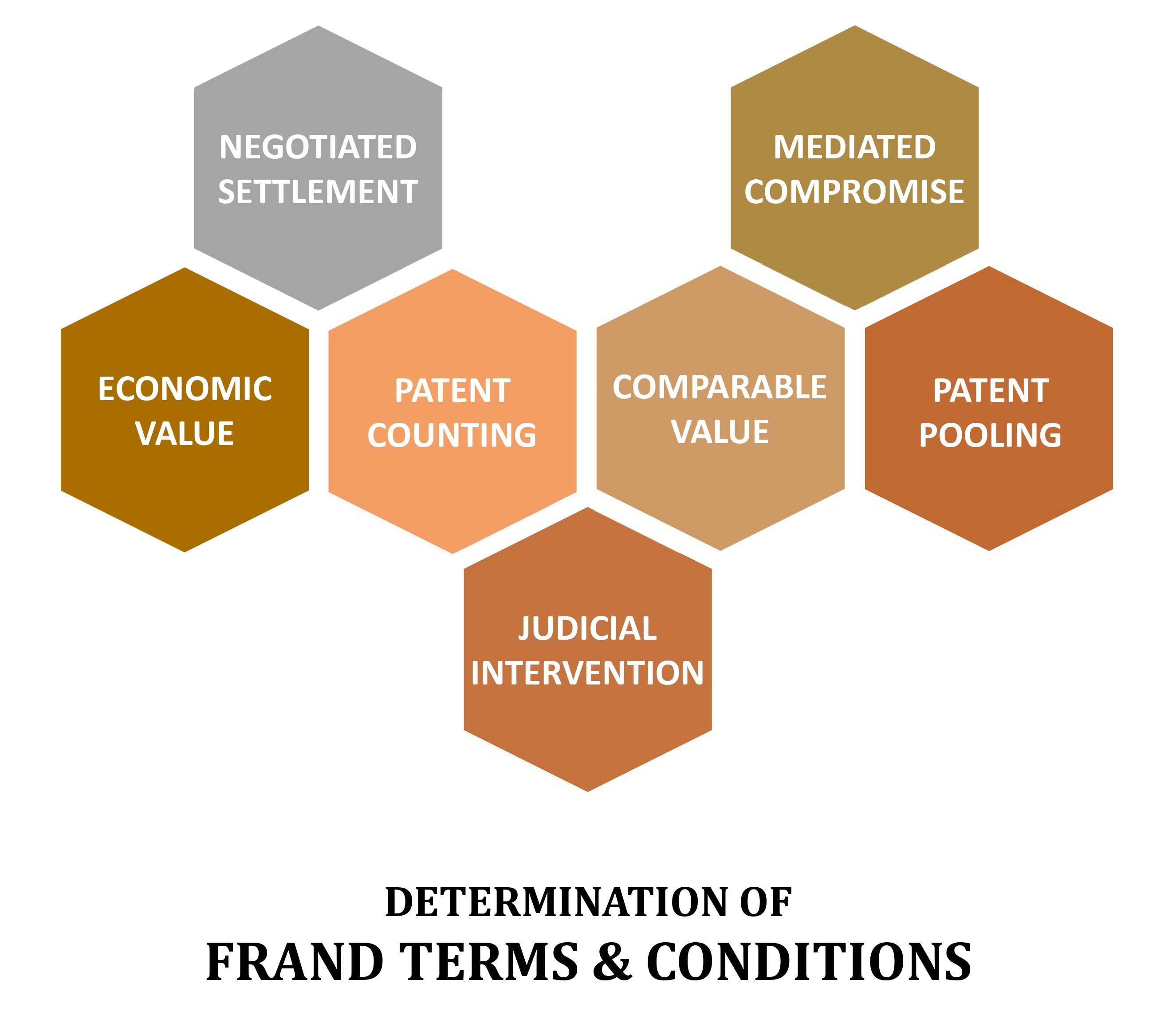
FRAND terms and conditions (T&C) are usually finalized using several methods, including bilateral negotiations; reliance on comparable transactions and industry benchmarks; mediated settlements; and, if such amicable means fail, litigation, arbitration or other dispute resolution method.
T&C determination may generally entail the following approaches:
Bilateral Negotiation: Offers and counter-offers are exchanged in good faith. Parties often examine, or “unpack” existing comparable licensing contracts to assess what a similarly situated licensee pays for the technology.
Economic Valuation & Patent Counting: In the ‘Top-Down Approach’, the aggregate royalty for all essential patents in a standard is calculated, and then divided proportionally on the basis of the numerical and technological strength of the particular licensor's patent portfolio.
Comparable Value: Subject matter experts review past data on negotiated rates for similar technologies and determine the percentage of the product's selling price that can be legally attributed to the SEP in question.
Patent Pooling: Often, competing SEP holders pool their portfolios together to offer a single licensing package to product developers and manufacturers. The accumulated royalties are then distributed among the patentees.
Mediated Settlements: International organizations, such as the World Intellectual Property Organization (WIPO), provide time- and cost-effective mediation services to assist in the economic valuation of SEPs and settlement of disputes.
Judicial Processes: If parties cannot reach a licensing agreement—often resulting in either: (i) a "patent hold-up", wherein the patent owner demands too much; or, (ii) a "hold-out", in which the manufacturer refuses to pay—they may go to court. Courts evaluate the evidence, determine the SEP's technical contribution and worth thereof and legally set a binding FRAND royalty rate.
Concluding Remarks
In spite of the widespread acceptance of FRAND terms in SEP licensing, the determination of FRAND royalties remains a contentious issue in patent law. There is also a universal acknowledgement of the need to avoid royalty stacking when many SEPs cover a single product. FRAND disputes typically involve questions regarding injunctions, negotiations, and the mutual covenants and obligations of the parties.
FRAND licensing has become a cornerstone of modern technology markets by promoting interoperability, reducing barriers to market entry, and encouraging investment in R&D. While it does not prescribe a standard royalty rate or licensing model, it provides a flexible framework of principles that seeks to reward innovation while ensuring that essential technologies remain broadly accessible to manufacturers and consumers alike.
At BLAZE VENTURES, we have elaborate processes and qualified professionals for advising inventors and enterprises strategically on the effective creation, protection and commercial exploitation of IP rights over their ideas, innovations and inventions in multiple jurisdictions.