For startups and founders, a good understanding of patent ownership is critical, not just for legal compliance, but also for maximizing the value of intellectual property (IP). The answer, however, depends on how and where the invention was developed, the agreements in place, and strategic business considerations.
As is well known, enterprises and other establishments, such as, universities, academic institutions, research laboratories, etc., extensively engage in scientific research and product development activities. Such entities and organisations get their inventions patented for the purpose of commercially protecting and monetising the intellectual property therein.
By default, patents are typically owned by the individual who conceives the invention, that is, the inventor. Basically, unless there is an express agreement or arrangement that transfers rights to a business entity or other organisation, the inventor(s) is/are the first owner(s). This principle applies across most jurisdictions, including India, the US, the UK and Europe, although the specific rules may vary.
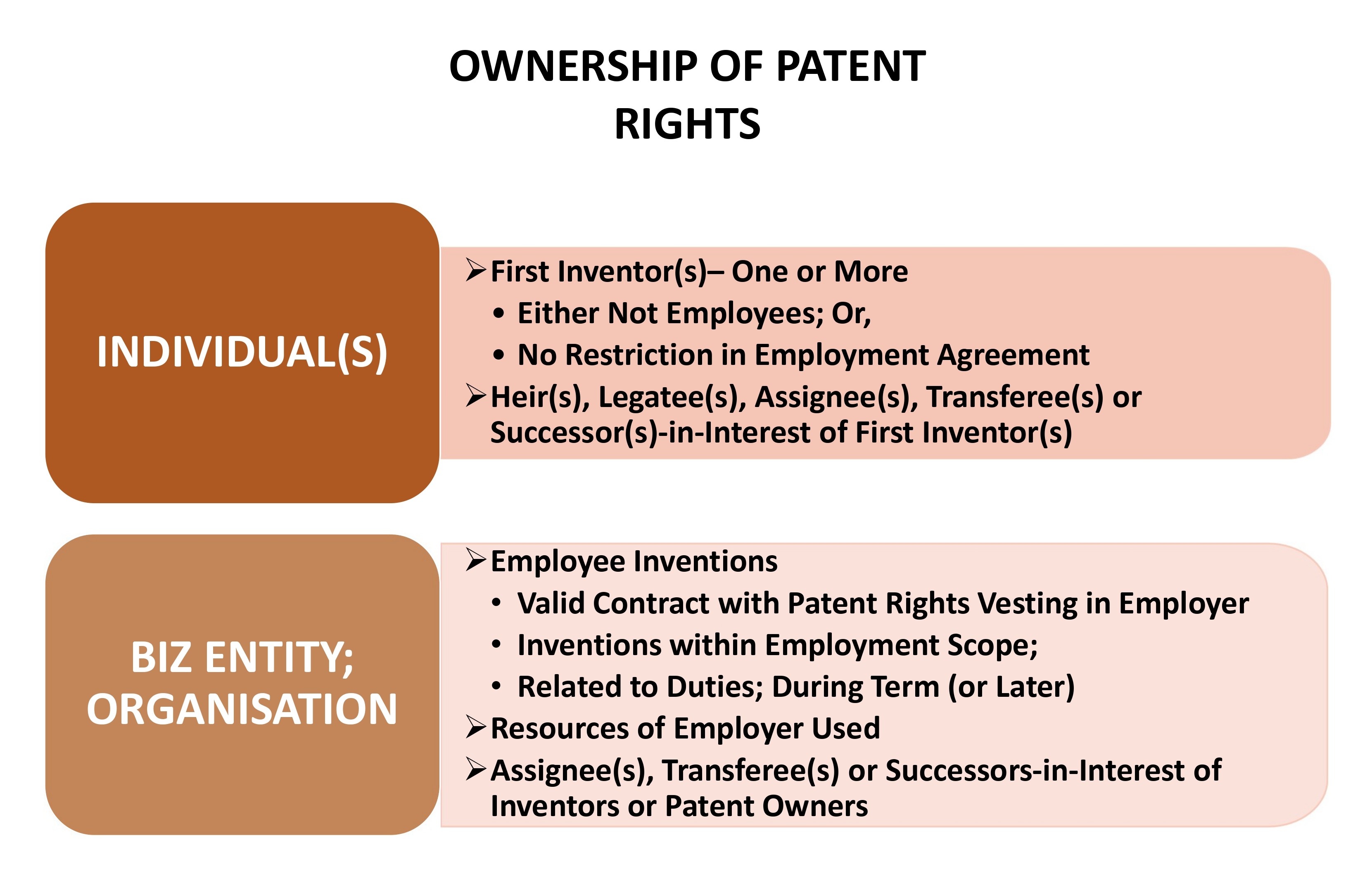
Hence, if, during the term of employment, an employee invents something that: (i) falls within the employment scope, as defined in his duties and responsibilities; or, (ii) is the result of work assigned; or, (iii) is accomplished with the use of company resources, then the employer gains ownership rights automatically, unless a different agreement exists. Such agreement, though, has to be contractually-binding and enforceable.
A patent can have multiple owners too. In the absence of an agreement to the contrary, ownership rights over patents with multiple inventors are typically shared equally and held jointly with undivided ownership rights. Furthermore, such multiple owners may have differential rights in respect of licensing, monetisation and enforcement.
Founders and employees often work under agreements that have express provisions for the vesting of patent rights and ownership in the employer. Some contracts may further restrain employees from creating patent rights and registering IP rights for anyone other than the employer during the course of employment.
The owner(s) of patents has/have the exclusive rights to make, use, sell and license the invention for a set period, which is typically twenty years. The patent owner can commercialize the invention in numerous ways and also initiate legal action against anyone who infringes on the patent rights.
In cases of joint patent ownership, each co-owner can use the patent for their own benefit without needing the consent of the other co-owners; but all co-owners must jointly agree in writing to license(exclusively or not) the patent to a third party. For the transfer of patent ownership to be legally valid, it must be properly recorded with the relevant jurisdictional patent office.
Patent ownership is not just a legal formality; it is a strategic business decision. Clear and unambiguous contractual provisions in respect of patent ownership ensure that innovations are fully protected and the company remains investment-ready, with minimal scope for disputes.
Enterprises, in particular startups, should proactively make provisions for ownership rights over patents through employment contracts, founder agreements, and IP assignment clauses. For startups, it is generally more advantageous for the company to own patents. It consolidates IP assets, simplifies investment negotiations, and creates a clear structure for licensing or sale.
However, in scenarios where an individual develops IP entirely independently, retaining personal ownership may be beneficial, especially if the invention is being monetized outside the company or prior to the startup’s formation.
At BLAZE VENTURES, we have elaborate processes and qualified professionals to advise inventors and enterprises on “patent ownership” by guiding them on the adoption of the ideal strategy and determination of the best ownership model for maximizing the commercial and competitive value of their ideas, innovations and inventions.