“Patent validity”, also frequently referred to as “patent term”, is the time period during which a patentee enjoys exclusive rights over an invention. During pendency of this time, the patent holder or owner can enforce rights to prevent others from the use, making, sale, or import of the patented invention without authorization.
The patent validity period is harmonized across all jurisdictions pursuant to the provisions of the Agreement on Trade-Related Aspects of Intellectual Property Rights (TRIPS). Signatories to TRIPS must provide the same level of protection to IP rights.
As a general global standard, a utility patent is valid fora period of 20 years from the filing date of the application. The filing date does not refer to the date of grant of the patent. It refers to the date on which the provisional application was filed—or, in the absence of filing of such provisional patent application, it is the date of filing of the complete-specifications application.
Thus, in practice the effective period of exclusivity may be shorter than the stipulated 20 years, since the patent office may take several years to process the patent application. In other words, the time elapsed between filing of patent application and the grant of patent is included in the period of 20 years.
For patent applications filed through the Patent Cooperation Treaty (PCT) route, the 20-year term is calculated from the international filing date, not the national phase entry date. Further, in most jurisdictions, different validity norms are applicable for design patents, which pertain to aesthetic appearance or ornamental aspects of a manufactured product. The period for enjoying exclusive rights over such visual designs is measured from the grant date and not the filing date.
Patent validity is not automatic for the entire 20-year period. The patentee is required to pay annual renewal or maintenance fees to keep the patent in force. Failure to pay the annual or periodic renewal fees, as may be applicable, within the prescribed time may result in the lapse of the patent, even if the 20-year term has not expired. Thus, patent validity is contingent upon continued compliance with statutory requirements.
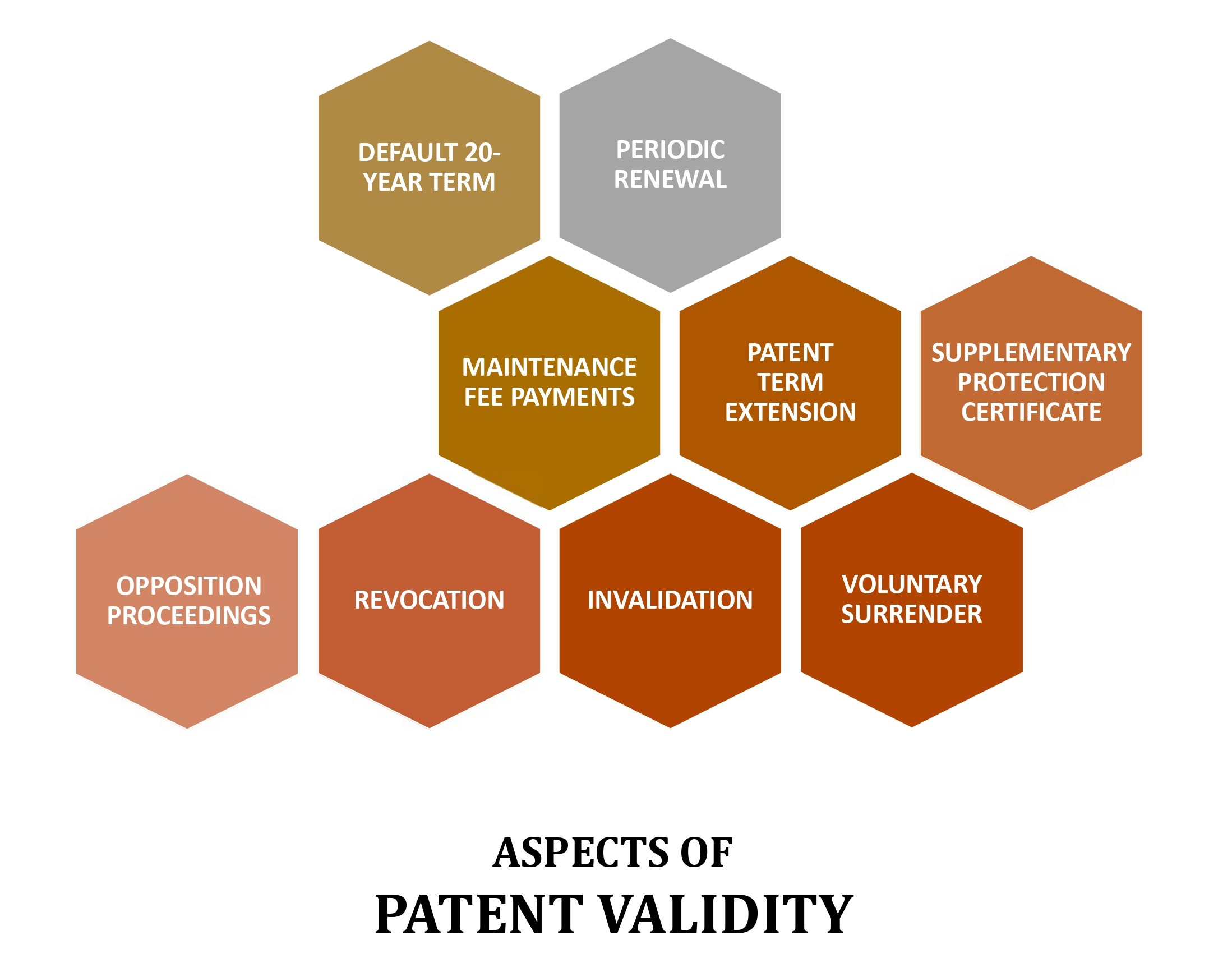
There are a few exceptions to the standard 20-year term. Some countries allow patent term extensions and supplementary protection certificates—in particular for agrochemical and pharmaceutical patents—to compensate for time lost in obtaining regulatory approvals. But such extensions are not available in many jurisdictions, such as, India, Brazil, etc., and all utility patents expire uniformly after 20 years.
Patent validity may end before the 20-year period. Such premature lapse occurs typically due to non-payment of renewal fees. Hence, it is pertinent to remember that the 20-year term for utility patents is contingent on timely fee payments.
A patent may also cease to be valid before the expiry of its full, 20-year term consequent to revocation by a court, opposition proceedings, or voluntary surrender by the patentee. Once a patent expires or lapses, the invention enters the public domain, allowing unrestricted use by the public.
To summarize, the duration of patent validity is essentially a 20-year monopoly from the filing date, subject to legal viability and sustainability. Patent management entails ensuring that the exclusive IP rights over the invention remain valid throughout the commercial lifespan of the patent.
At Blaze Ventures, we have elaborate processes and qualified professionals for strategically advising inventors and enterprises on the duration of patent validity, which directly impacts commercialization strategies and return on investment.