Inventorship is a foundational concept in patent law; it helps identifying the person(s) who has or have the legal right to be named as the creator of an invention. Inventors are the ‘true and first’ creators who actually conceived and contributed to the invention's development, not just those who reduced it to practice or funded it.
In other words, an inventor is an individual or natural person, who contributed intellectually to the conception of at least one claim or part in the invention in the patent application. Conception refers to the formation and development of a definitive and permanent aspect of the final, operative invention.
In most countries, the person who invents and discloses the invention first will legally be entitled to be declared as the true and first inventor. If only one person has contributed to the conception, then he or she is the sole inventor.
Inventions are often the result of collaborative efforts. If two or more persons have contributed, then all of them are joint inventors despite not having worked together physically or contributed equally. Importantly though, such joint inventors need not contribute equally; nor must they work together at the same time or place. But each joint inventor must have made a salient intellectual contribution to one claim in the least.
A patent may be validly granted to such person, despite the invention having been previously invented by another person who failed to file a patent application thereon or otherwise disclose it. Therefore, most patent law systems are based on first-to-file, rather than first-to-invent approach.
Exclusions may be applicable to the definition of inventorship depending on jurisdiction. For instance, in India, the term ‘true and first inventor’ does not include both the first recipient of communication about an invention from outside India and the first importer thereof into India.
It is obvious that conception, that is, cognitive and intellectual aspects, is the touchstone of inventorship. Courts have held that a person who contributes any part of his skill, ingenuity, mental faculty or technical knowledge towards the invention is an ‘inventor’. Therefore, an inventor must have contributed to the intellectual formulation of the invention, that is, its "Aha! Moment”.
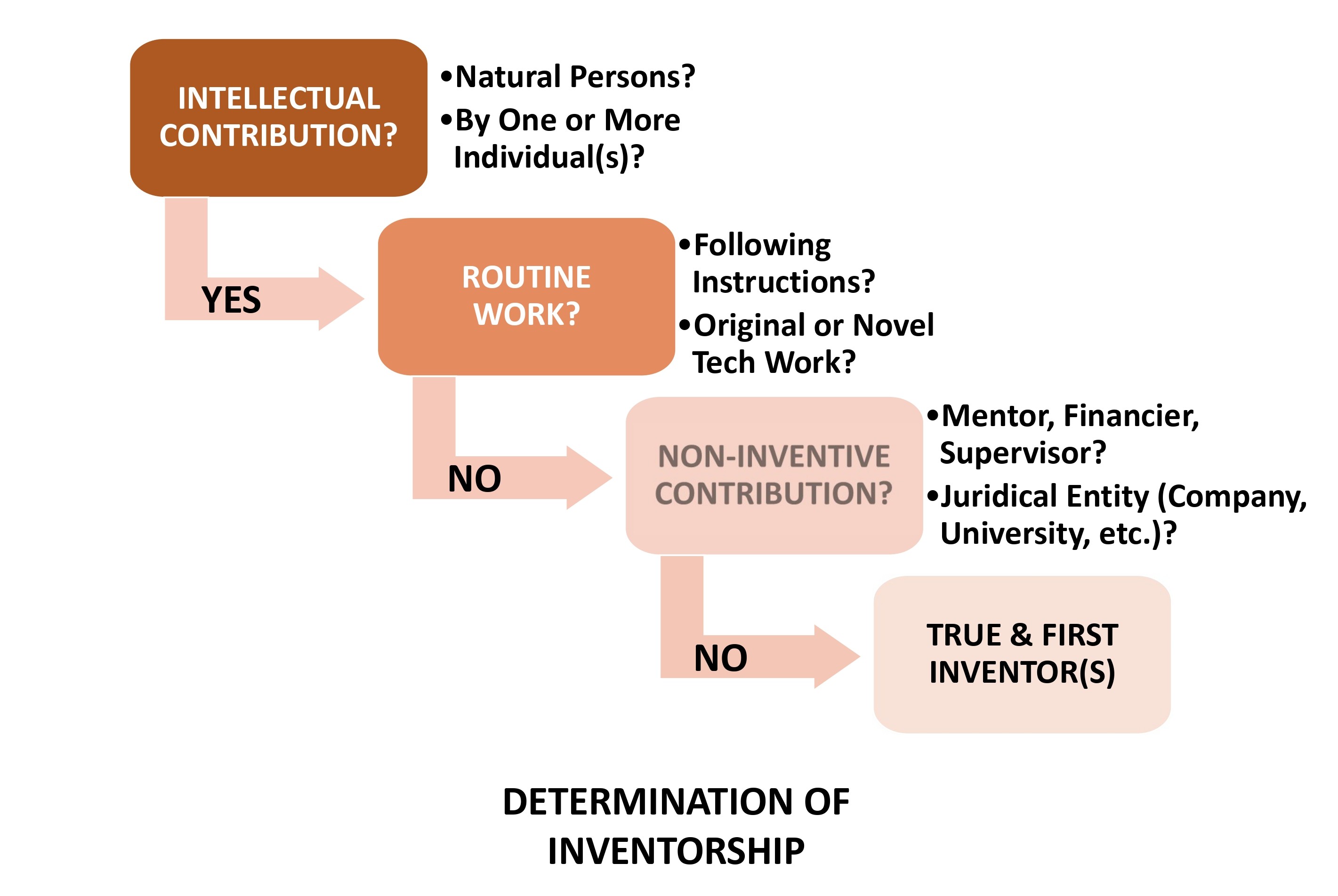
It is therefore not enough to merely assist in the reduction of an invention to practice—such as, by performing experiments or following instructions, and not contributing inventively to the core idea or providing intellectual input thereon.
Hence, lab assistants, technicians, engineers, or employees, who only provide routine, non-novel technical work, related to the development of the invention, are not considered inventors.
Similarly, mentors, supervisors, or financial partners, who did not contribute conceptually or intellectually to the invention, are not inventors either. Neither can a company, university, or AI-system be an inventor; only humans are eligible.
In many countries, inventors are statutorily the initial owners of patent rights, unless those rights are contractually assigned to an employer or another entity; or, such rights have devolved through succession or survivorship or otherwise to a successor-in-title due to death, bankruptcy, winding up, etc.
In other jurisdictions, while the inventor must be named, the applicant (often the employer) is typically the entity that files and holds the patent rights. Nonetheless, proper attribution of inventorship remains mandatory.
Ownership of a patented invention can be transferred or assigned. However, inventorship is tied to the person(s) who contribute(s) intellectually to the ideation and development of the invention. In general, the inventor is the creator; the owner is the person, oftentimes a company or assignee, who files the patent application.
Hence, the proper identification of inventors is crucial, because errors in inventorship can jeopardize the validity and enforceability of a granted patent. For instance, omitting a true inventor or adding anon-inventor can lead to disputes and potentially invalidate a patent.
Errors in inventorship can be corrected, provided there was no fraud, deception or misrepresentation. Patent laws in many jurisdictions allow amendments to the list of inventors during prosecution or even after grant, subject to procedural and statutory stipulations.
In conclusion, inventorship is a critical aspect of patent protection that ensures proper recognition of intellectual contributions. It serves as a legal prerequisite and safeguard for the integrity of the patent system. Accurately determining inventorship not only protects patent validity, but also upholds fairness in an increasingly innovation-driven world.
At BLAZE VENTURES, we have elaborate processes and qualified professionals to help inventors effectively protect IP rights over ideas, inventions and innovations.