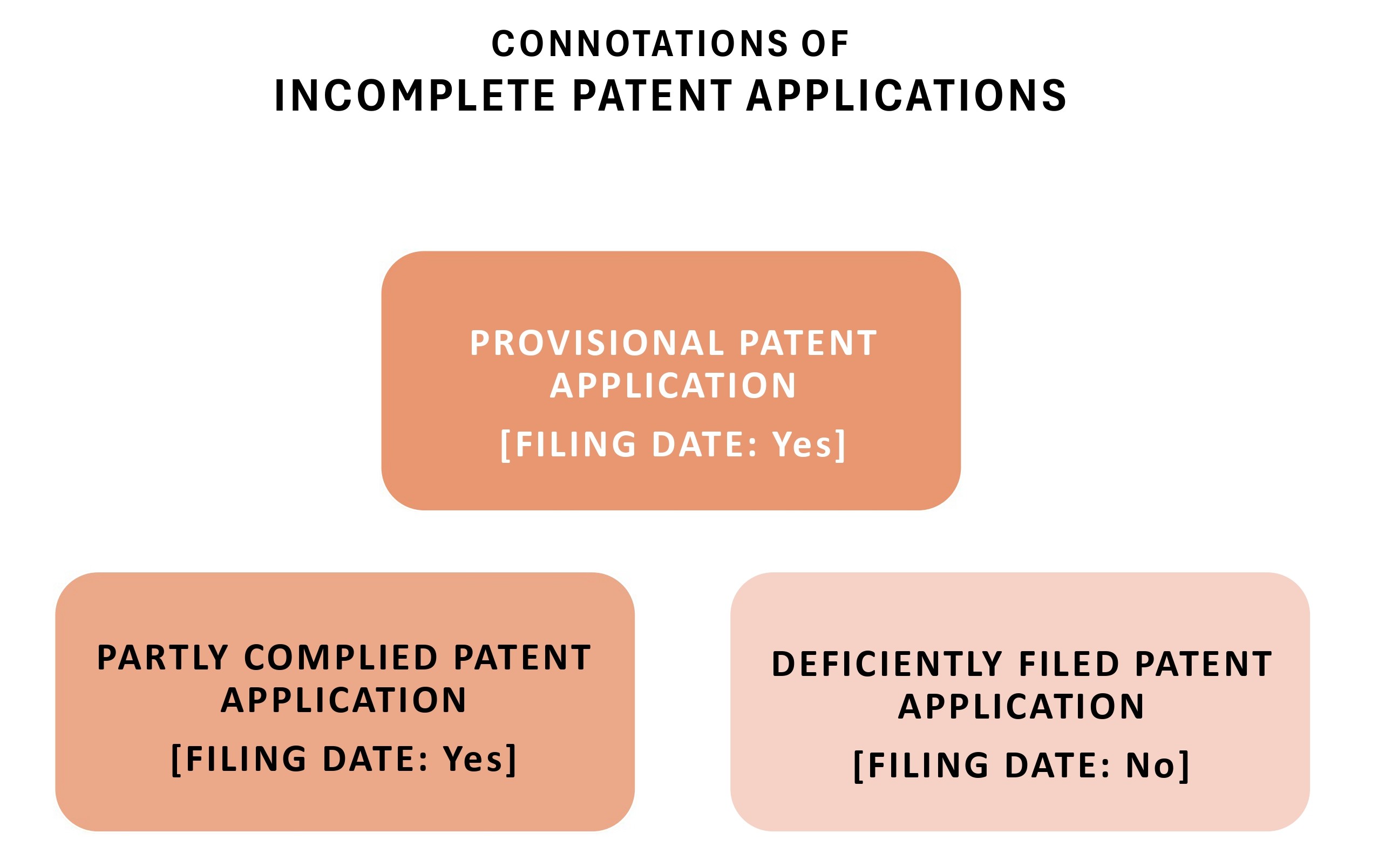
The term “incomplete patent application” has multiple connotations.
It often refers to a provisional patent application, which is a preliminary, legally-recognized filing made to get an early priority date by excluding detailed descriptions, formal drawings, or complex legal claims of a full/complete application. It acts as a placeholder, while the development of the invention is continued.
It may also refer to a ‘deficient filing’ or other procedural error made in a provisional or non-provisional application. In that context, it denotes a failure to include all the mandatory parts of the application. Such omission may be in respect of either non-inclusion of mandatory parts/documents of the application, such as, specifications, drawings, etc., or non-payment of filing fees. In such scenarios, a priority or filing date will not be given till all defects are cured and statutory provisions complied with.
In some geographies, an “incomplete patent application” references an application that does not satisfy the formal or substantive provisions prescribed minimally under the relevant act and rules framed thereunder. Thus, an incomplete application is an initial filing with the patent office that fails to meet all minimum statutory requirements for establishing a formal or official filing date.
For instance, in Canada, the patent office prescribes documentation, which are minimally required to obtain a filing date. An application can be filed with just the applicant identified and a general description of the invention. However, additional documents may still be required to be furnished; and, procedural provisions―such as, engagement of patent agent; payment of prescribed fees, etc.―complied with.
If, on its filing date, an applicant fails to meet any requirement other than the payment of the applicable fee, then the patent office issues a notice directing the applicant to cure the deficiencies within a prescribed date. Such a deficient application is considered “incomplete” and failure to rectify the defects in a timebound manner results in the application being deemed ‘abandoned’.
The concept of incomplete applications is significant in countries with a first-inventor-to-file system, where an early filing date can be crucial. The provisions reflect an endeavour to balance administrative efficiency with fairness to applicants.
Nonetheless, an incomplete disclosure, which does not adequately describe the invention or enable a person skilled in the art to practise it, cannot be cured by adding new matter after filing it.
At BLAZEVENTURES, we have elaborate processes and qualified professionals for advising inventors and enterprises strategically on the effective creation, protection and commercial exploitation of IP rights over their ideas, innovations and inventions in multiple jurisdictions.