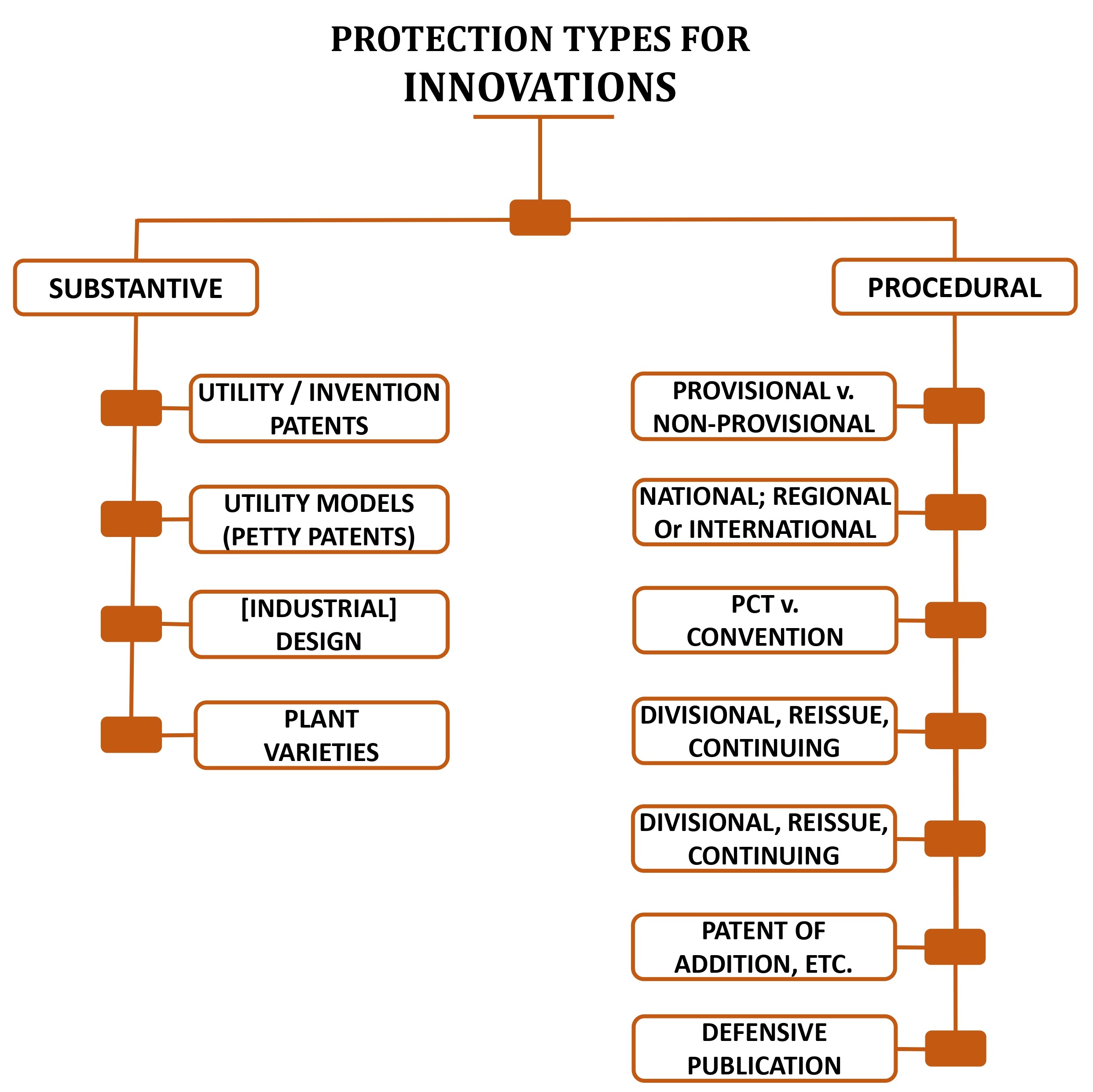
Innovation is the cornerstone of global economic growth, and patents are a vital aspect for creating and protecting ownership rights over such innovative ideas. In most patent systems worldwide, patents fall into a few well-defined categories depending on what is being protected and the level of inventiveness involved.
The categorization can also be based on the extent of protection afforded.
This category protects inventions that have a functional benefit. Inventions that possess utilitarian value, are novel, involve an inventive step and are capable of industrial application are eligible for protection of this category. This type of patent is valid for a period of 20 years from the date of filing, subject to renewal fees.
A utility patent confers on the patentee exclusive rights to prevent others from making, using, offering for sale, selling, or importing the invention without permission. This class of inventions includes novel products, compositions of matter, apparatuses, devices, processes, machines, methods, equipment, formulations, and improvements thereto. Examples include pharmaceutical formulations, chemical compositions, mechanical devices, etc.
In some regions and countries, such as, China, Japan, Germany and Brazil, the laws provide protection for ‘minor inventions’ through the utility models (or petty patents) system, which is similar to the patent system. These are minor, incremental inventions that may not fulfil the patentability requirements of invention patents.
The protection afforded to utility models is for a shorter duration; in general, the exclusivity rights are granted for a term of 6-10 years. It is easier, cheaper and faster to secure (often with no substantive examination) utility model protection for innovative ideas in jurisdictions wherein they are recognized. This type of IP is best suited for simple mechanical devices and minor enhancements to equipment.
A design comprises of the visual appearance, aesthetic elements and ornamental characteristics embodied in, or applied to, an article of manufacture. It does not pertain to the technical and functional aspects of such article.
In most regions and countries, the intellectual property in such designs can also be protected under the relevant patent laws. In several jurisdictions, separate laws have been enacted for registering industrial designs.
However, since a design is manifested in appearance, the subject matter of a design patent application may relate to the shape or configuration of an article, to the surface ornamentation applied to an article, or to the combination of configuration and surface ornamentation. The term of protection afforded to a design patent in most jurisdictions is usually 10-15 years, during which time the owner of the design can stop others from applying the same or similar design to products for commercial purposes.
Thus, any unique or distinctive design, that is, shape, motif, pattern, ornament, decoration, finishing touches, configuration or composition of lines or colors, applied to the design of any two- or three-dimensional article or object, by any manual, chemical, mechanical or other means, can be registered.
Often referred to as plant patents, these protect new plant varieties that have been asexually reproduced in some jurisdictions, such as the US. Distinct, uniform and stable (DUS) plant varieties derived through agricultural innovation can also be safeguarded globally under the International Union for the Protection of New Varieties of Plants (UPOV system). The term of protection usually varies from 15-25 years.
The protection can be sought and granted for any new, extant or essentially derived plant variety satisfying the DUS criteria. Such varieties can be functionally superior, in respect of yield, pest resistance, immunity to weather variations, drought resistance, etc. The breeder then gets the exclusive rights to produce, sell, market, distribute, and import/export the protected variety.
IP protection applications are also categorised on the basis of filing methods and procedural differences, such as: (a) provisional versus non-provisional; (b) national or regional versus international; (c) Patent Cooperation Treaty (PCT) versus Paris Convention; (d) divisional, re-issue and continuing applications;(e) defensive publications; (f) patent of addition; etc.
Understanding these distinctions helps to better protect intellectual creations, inventions, innovations and technical advancements. Strategic IP protection not only guards against imitation, but also potentially yields monetary returns and enhances commercial value.
At Blaze Ventures, we have elaborate processes and qualified professionals for strategically advising inventors and enterprises on the effective creation, protection and monetisation of intellectual property rights.