In a rapidly evolving technological landscape, innovation is a critical driver of progress. Patents play a pivotal role in this ecosystem by offering inventors exclusive rights to their creations, incentivizing further innovation and investment.
However, not all inventions are equally deserving of patent protection. The concept of patentability is about assessing the likelihood of a patent grant for your invention. It rests on several prerequisites, including novelty, non-obviousness and utility. Understanding these criteria helps clarify the boundaries between truly innovative solutions and incremental or unoriginal ideas.
But, the million-dollar questions remain: Should you seek patent protection for your invention? Is a patent worth the expenses you incur on obtaining it? If so, when and how do you decide whether to file a patent application?
Patentability refers to whether the invention satisfies the legal requirements to merit the granting of a patent. In other words, it focuses on criteria, such as, novelty; non-obviousness (or inventive step); utility (or industrial applicability); patentable subject matter; and, so on. Any invention that meets these criteria will be deemed patentable.
Patent worthiness, on the contrary, deals with whether pursuing a patent makes business or economic sense for a particular invention. Hence, an invention might be patentable but not patent-worthy, if, for example, it is not commercially viable or the cost of obtaining and maintaining the patent outweighs its potential benefits.
Itis apparent that beyond the legal and technical pre-requisites of patentability, the commercial value of an invention often determines whether pursuing a patent is worthwhile. Even if an invention meets all the patentability requirements, the cost of applying for and enforcing a patent can be substantial.
If the invention has limited market potential or is unlikely to attract investment, then obtaining a patent may not be economically justified. Conversely, a patent on a breakthrough process, design or product can be highly valuable. A patent can be a gamechanger for such an invention, offering competitive advantages and serving as a basis for monetization of the invention through sales, licensing, partnerships, venture capital funding, etc.
In short, patent worthiness delves into whether it is worthwhile to have an invention patent protected. Thus, it is evident that the terms ‘patentability’ and ‘patent-worthiness’ are related; yet, they refer to distinct concepts.
Various factors are relevant for determining the patent worthiness of an invention. Commercial value of the invention is often dependent on factors, such as, market potential, cost of patenting, expected return on investment (ROI), ease of enforcement, competitive advantages, likelihood of infringing other patent(s), alignment with business goals, etc.
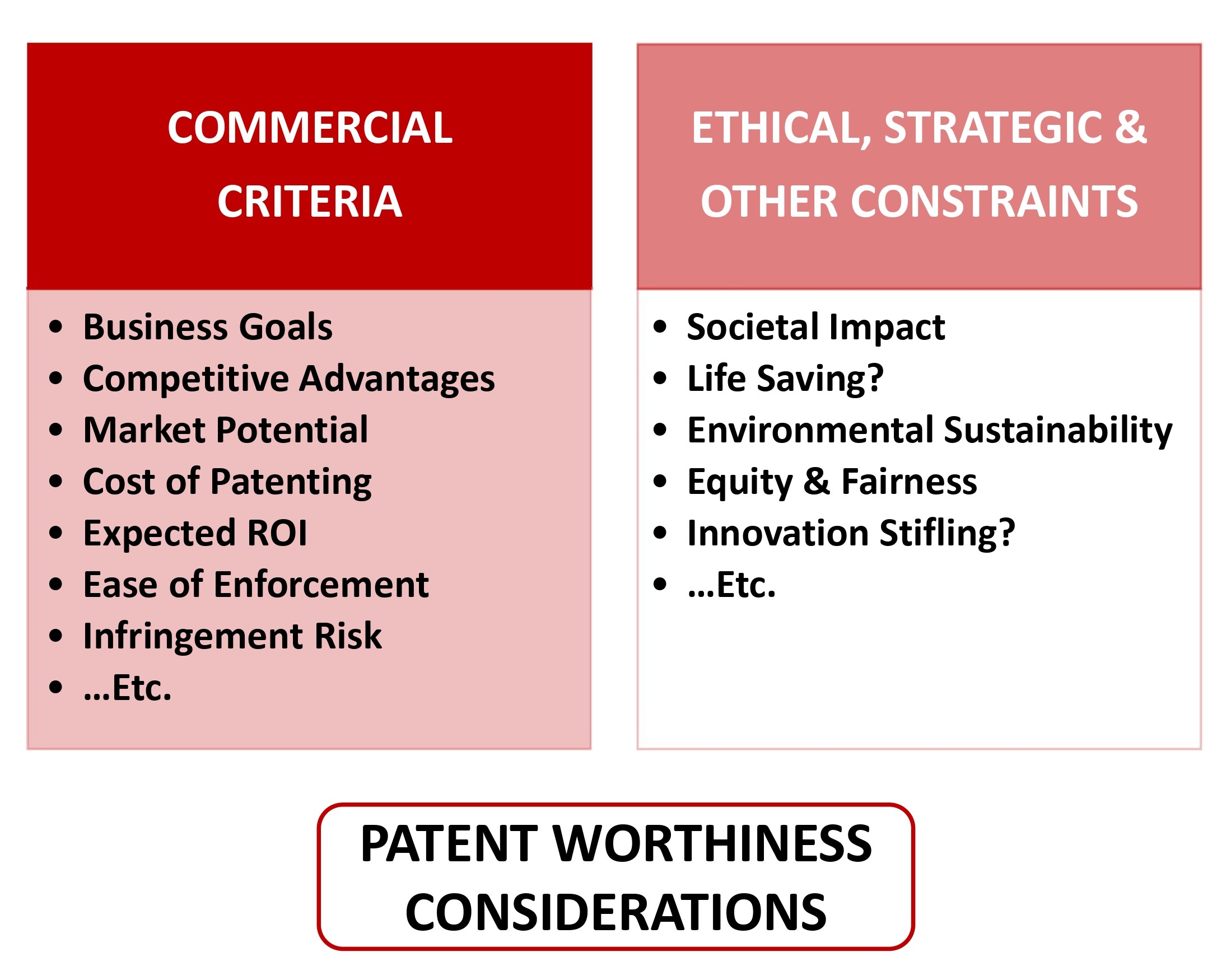
Ethical and strategic considerations may also influence perceptions of patent worthiness. Some inventions, such as life-saving medicines or environmentally sustainable technologies, may be viewed as more worthy of protection due to their broader societal impact. Other inventions, like those on basic genetic information or software algorithms, may raise concerns about fairness, accessibility, and innovation stifling.
Thus, patent worthiness is a multifaceted concept that blends legal standards with commercial, ethical, technical and strategic considerations. Ensuring that only truly worthy inventions are granted patents is essential for sustaining an innovative and equitable technological future.
At BLAZE VENTURES, we have elaborate processes and qualified professionals for advising inventors and enterprises on the “patent worthiness” of ideas, innovations and inventions.